A formerly cross-continental & cross-apartmental, now cross-town discussion on film featuring Owen and Matt

Showing posts with label thriller. Show all posts

Tuesday, April 12, 2011

Carnival of the Animals


(Because there's never a bad time or too tenuous an excuse to throw in a little reference to the great Saint-Saëns, hence the post title.)
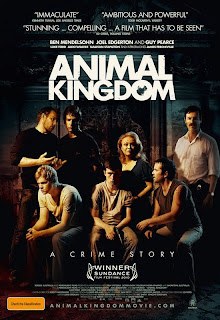
There are plenty of films out there that center on crime—crime dramas, crime thrillers, even "crime epics." (A very good example of the last category would be last year's terrific two-part biopic Mesrine (trailer) starring Vincent Cassel, epically spanning decades and continents.) This is only natural; the tension and danger simply make for good storytelling, and the transgressiveness of it is exactly what most people would love to experience vicariously. The centerpieces of such films are usually the crimes themselves—the heists, the hits, etc. Rare is the crime movie that doesn't give the audience that adrenaline rush, that payoff, but instead focuses on the criminals when they're past their prime, when the main concern isn't the next score but simply staying out of prison or even staying alive. That's the kind of film Animal Kingdom (trailer) is, an outstanding little downer of a crime film from Australia that's one of the best films of last year.

The film centers around J (James Frecheville), a laconic (indeed, seemingly emotionless) seventeen-year-old boy whose mother OD's on heroin and is taken in by his grandmother and uncles, a band of notorious armed robbers. There's the hyperactive, drug-dealing Craig (Sullivan Stapleton), Darren (Luke Ford), barely older than J and not showing much stomach for the work, and their relatively level-headed friend and parter Baz (Joel Edgerton, very much reminding me of an Australian Prince Colwyn from Krull); rather than playing the "Ma Barker" role, J's grandmother Janine (Oscar-nominated Jacki Weaver), as J puts it, "just wanted to be where the boys were" (though her role changes as matters become more desperate). Rounding out the crew is J's third uncle, the volatile Andrew, called "Pope" (Ben Mendelsohn), who's been in hiding from the Melbourne Police's increasingly ruthless armed-robbery unit. We never really see them in action, but instead watch as growing police pressure causes them to push back as much as they can against the authorities and to lash out against one another.

All this is seen through the eyes of young J, whose initial position as an outsider with relation to his family makes him an ideal window through which the audience can be introduced to them and their way of life. As the story goes on, however, we see him transition from a Nick-Carraway-like passive observer to the story's principal mover.

Though he's been making short films for the past several years, Animal Kingdom is director David Michôd's first feature-length effort, and with that in mind it's extraordinary in its confidence, grace, and expert command of both narrative and performances. (In that respect, I'm reminded of another of the best directorial débuts of the last few years, Tom Ford's A Single Man, reviewed here.) Speaking of performances, while every one is solid, there are a few that particularly stand out for recognition: Frecheville's J, a shell-shocked young man trying just to get along amidst the growing danger in which he finds himself, before being forced to take matters into his own hands; Weaver's Janine, a seamless blend of motherly affection when she can afford it and ruthless determination when she can't; and Guy Pearce's understated performance as Sgt. Leckie, a police detective who's both determined to do his job the right way and is possibly the only person genuinely concerned about J's welfare.

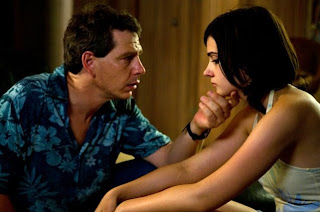
However, a discussion of the film's performances would be incompete without mentioning Mendelsohn as Uncle Pope. He simply steals every scene he's in, with a pervasive air of menace that's a blend of brutal thuggishness and manipulative cunning. His bestial nature (pun intended) is only accentuated by Mendelsohn's almost simian appearance, with his slouched posture, sloping forehead, heavy brow, wide mouth, and weak chin. (I hate to sound like some nineteenth-century criminal phrenologist here—"You have the brainpan of a stagecoach tilter!"—but his looks really do add to how sinister and threatening his character seems.) In a film full of terrific performances, Mendelsohn is the acting MVP.

There's a particular scene—what I call "the 'All Out of Love' scene"—that not only showcases the best of Michôd's technique as a filmmaker in a film full of terrific cinematic craft, but also is guaranteed to change the way anyone who watches it feels about Air Supply's classic syrupy ballad. I don't want to give it away by describing it too much, but it's just such an incredibly effective marriage of photography, sound (both the song itself and the low, eerie hum playing over it), editing, and performance, with Uncle Pope at his most terrifying without needing to do more than just sit and stare. It's easily one of last year's most arresting, effective examples of filmmaking technique to be found in a single scene, alongside the crew race from The Social Network (showy, yes; superfluous, no), the dream-dance that begins Black Swan, Aron's severing his arm in 127 Hours, or any one of the food-preparation or -consumption scenes in the foodie porn flick that is I Am Love. (Admittedly, 2010 wasn't a great year, but there were a few memorable moments.)
As a matter of fact, the "All Out of Love" scene reminded me simultaneously of the work of not one but two of the greatest living filmmakers, Scorsese and Lynch. Scorsese is known for his visionary use of popular music, from "Layla" in Goodfellas to "Be My Baby" and "Please Mr. Postman" in Mean Streets, all the way back to the eponymous song in his under-seen début, Who's That Knocking at My Door. Though I'd hesitate to call it Scorsesian, the use of pop music in Animal Kingdom certainly is imaginative and effective, from the aforementioned Air Supply to Jimmy Cliff's "Sitting in Limbo" playing as the family leasurely walks down the sidewalk before being abruptly cut off as the film cuts to the next scene. As for Lynch, Michôd often creates a haunting, threatening, dreamlike atmosphere that could be straight out of Blue Velvet, Lost Highway, or Mulholland Drive; he does this using slow, steady, elegant camerawork, careful use of focus, and a low, ominous soundtrack that gives a great sense of the tension and fear in which J and the others live. While Michôd's obviously not the first to use such filmmaking tools, it's clear that he knows how to use them well, as that scene perfectly demonstrates.

Though Animal Kingdom certainly qualifies as a "crime thriller," someone expecting it to follow the more standard narrative course of that genre will be disappointed (or pleasantly surprised, one would hope). This is no Heat, no The Town. It takes the focus off of the thrilling, fast-paced, often glamorous crimes themselves and puts it on the consequences, as they start to catch up with our "heroes" and push them to do worse, more desperate things to those closest to them. And this story is told with more grace, passion, and tension through its whole running time than most films manage for a scene at a time. If Animal Kingdom is any indication, we can expect David Michôd to become one of the great new directors of the years to come.

(And as a reward for reading this far, here is the sublime "The Swan," from Saint-Saëns's "The Carnival of the Animals," performed by Yo-Yo Ma. Enjoy, you earned it.)

Wednesday, March 23, 2011

12 Monkeyhog Day


Last week, some colleagues and I got an early look at Source Code (trailers), the sophomore effort from friend of the blog Duncan "Zowie Bowie" Jones, as well as an all-too-brief look at the man himself. First, the Jones appearance. Like a small, English Bigfoot caught in a grainy home movie out in the woods, he seemed to pass in front of our field of vision only long enough for us to wonder if what we were seeing was the real thing before he strode back behind the treeline. During the sighting, he seemed to be trying to lower expectations a bit among the Moon fans like us in the audience (sadly, too few in the free screening), telling us not to expect his second film to be all that similar to his terrific first. (Whether he meant in terms of its subject matter or its quality, he didn't specify.) After maybe forty-five seconds at the mic, Jones hurried off, leaving the lights to fall and his film to speak for itself.

Though Source Code certainly is different from Moon, and not as good, neither it nor Jones has anything to be ashamed of for what it is, which is a gripping, engaging, well-above-average action movie. Colter Stevens (Jake Gyllenhaal) abruptly comes to on a commuter train headed for Chicago, his last memory being piloting an Army helicopter in Afghanistan; he doesn't know where he is, what he's doing there, or why the stranger sitting across from him, Christina (Michelle Monaghan), seems to know him. After eight minutes, an explosion destroys the train, and Colter is now isolated in a small, dark room with few features other than a screen on which a militarily attired woman, Goodwin (Vera Farmiga), anxiously questions him about what he just saw. It's soon revealed to Colter that, using a technology called "the Source Code," his consciousness is being thrown into an alternate reality based on the last eight minutes of the life of one of the train passangers before he, Christina, and the other passangers were killed in a bombing, but an alternate reality that he can fully explore and affect. His involuntary mission is to discover who was behind the bombing in order to prevent other attacks predicted to follow; but he can only do this eight minutes at a time, reliving the last moments of a dead man's life over and over until he finds the truth.

The obvious point of comparison for Source Code is as an action/thriller Groundhog Day, but with our hero forced to relive the same eight minutes in order to prevent terrorist attacks, instead of forced to relive the same minor holiday in order to become a better person and get the girl. However, the film I was most reminded of was 12 Monkeys, in which a man from the near future is forced by a mysterious authority to travel back in time to gain intelligence about a past, seemingly inevitable catastrophe. (Hence the mangled compromise of this post's title.) Though Jones didn't write Source Code, it shares with Moon (which he did write) a ready willingness to borrow what it needs from other films, but with its own spin. (I already noted the influences of Silent Running, Solaris, Blade Runner, and 2001, to name a few, on Moon.) It uses a high-tech narrative device and action-movie setting to examine, like Ramis's and Gilliam's respective films, how inevitable or open-ended life actually is, whether we're in the driver's seat or the future is set in stone. Surprisingly heady stuff for a springtime actioner full of pretty faces.

Jones has openly described Source Code as a "one for them" film. (I believe the term he used was "director for hire.") But really, the only actual negativity I can direct at the film is relative, in comparison to the "one for me" Moon. Sure, Gyllenhaal, Monaghan, or Farmiga doesn't turn in anything like Sam Rockwell's extraordinary performance, possibly the best of his career; but everyone delivers solid work, especially Gyllenhaal with his character's blend of military professionalism and understandable frustration with the situation into which he's been forced. The story doesn't have the same surprises and thematic challenges, but it's still one of the most intelligent and compelling films of its kind that we've gotten in a while, and one that interweaves its intelligence with the action and suspence quite well, in both conception and execution. If this is Jones's "one for them" film, we should be so lucky as to have more like it during the rest of his career.

Wednesday, March 2, 2011

Gettin' Hitched


I've been trying the past couple years to broaden my acquaintance with the filmography of Alfred Hitchcock beyond just watching Psycho over and over again. I've seen Vertigo, Rear Window, The Birds, and Notorious, and they, along with Psycho, are some of the best films I've ever seen in every respect: storytelling, technique, performances, suspense, and, let's not forget, humor. There's always some kind of comic aspect to be found somewhere in his films, from the matronly patron fretting over humane pesticide in Psycho to the rarely seen newlyweds in Rear Window. Not only does it provide some much-needed lightening of the mood and balancing of the tone, but it goes a long way toward humanizing the characters, making us care about them more, and thus fear for them more. But no film of his that I've seen has showcased Hitchcock's comedic side as much as The 39 Steps.

We're introduced to our dashing young Canadian hero, Richard Hannay (Robert Donat), in a London music hall where patrons test the encyclopedic knowledge of "Mr. Memory" with often absurd questions (including the old man who keeps trying to ask his question even after shots are fired and the audience stampedes). He finds himself with a beautiful spy calling herself "Annabella Smith" (Lucie Mannheim), who claims to be trying to keep aeronautical secrets from being passed to a foreign power. (Structurally the film mirrors itself, beginning with a music hall followed by Hannay in the company of a woman, and ending with Hanny in the company of a woman followed by a music hall.) Annabella is soon murdered, but not before telling Hannay cryptically of "the Thirty-nine Steps" (perhaps the MacGuffiniest of all MacGuffins) and a man whom she was supposed to meet in Scotland. Now wanted for Annabella's murder, Hannay travels to Scotland to try to get to the bottom of the conspiracy and thereby clear his own name.

One great way that Hitchcock maintains the suspense is by constantly shifting Hannay's environment and whom he's with: from the music hall to his apartment, to the train to Scotland, to the cottage of the pious crofter (definitely a Calvinist, he) and his long-suffering young Glaswegian wife—and sorry to nitpick, but it would take a wee bit more than an afternoon's hike to get from the Forth Bridge to what's clearly supposed to be the Highlands—to Ard-na-Shelloch, and so on. He—and the audience with him—remains uncertain where he'll find himself next, and who he can trust there. I also liked how Hitch upset expectations; the foreign-accented femme fatale who freely admits her mercenary outlook is trustworthy, while plenty of respectable-seeming natives turn out to be traitorous foreign agents or their unsuspecting pawns.

There are also some great little filmmaking techniques and tricks sprinkled throughout, like the first shots of Hannay at the music hall where we don't see his face, the scream of the woman discovering Annabella's body blended with the whistle of the train Hannay's riding as he makes his escape, or the camera going from looking in the window of a moving car to suddenly stopping and watching the car drive off. They don't necessarily make the film more suspenseful, but they definitely make it more interesting and fun to watch.

As I mentioned before, The 39 Steps is shot through with humor; in fact, it's easily as much a comedy as a thriller. In that respect, I have to say the film it reminds me of the most is Pineapple Express; Dale and Saul are similarly on the run from a murderous conspiracy, but there are so many laughs that you almost forget the mortal danger they're in. In The 39 Steps, there's the aforementioned scene at the music hall, then Hannay's interaction with the milk man, the "unmentionables" salesmen and the old vicar on the train, and the (comedically ingenious) scene at the election rally. Then, when Hannay meets up (again) with the bizarrely appareled Pamela (Madeleine Carroll), the film becomes a quasi-screwball comedy, with much sexual-tension-infused witty bickering between an attractive young man and woman who can't help but find themselves in one zany situation after another. Though humor and romantic relationships are staples of Hitchcock's thrillers, The 39 Steps is the only one I've seen in which they're so central (except maybe the romantic aspects of Vertigo and Notorious, but there isn't nearly as much comedy in those).

I'm reminded of a story someone (I don't remember who) told about sharing an elevator with Hitchcock. The two of them were alone in the elevator; then, when more people started getting on, Hitchcock started into the middle of describing a gruesome murder scene with great detail and relish. Soon the elevator stopped, the doors opened, and the eavesdropping fellow-passengers hesitated a moment before leaving, not wanting to miss the end of his lurid tale. When Hitchcock and the storyteller were again alone in the elevator, the latter anxiously asked what happened next; but, as Hitch explained, nothing happened next, he just made it up on the spot to amuse himself with everyone else's reactions. Hitchcock clearly saw a natural link between humor and fear, between comedy and tragedy, and so was never afraid to infuse some humor into his thrillers, which only improved them. That's nowhere more evident than in The 39 Steps.

Saturday, January 15, 2011

Shame and eternal shame, nothing but shame!


That's Shakespeare, ya philistines!

So while I was writing my post on Phantasm last night (another wild Friday night for Owen!), it dawned on me that, of the films I'd watched recently, the one I was writing about was a goofy, low-budget, late-'70s supernatural horror movie, rather than, respectively, one of the most beautiful and moving films I've ever seen and a groundbreaking, chilling, thematically complex and brilliant thriller. A profound sense of cinephilic shame came over me, and I knew I must do something to make amends. So here goes.

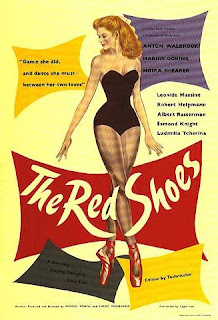
The Red Shoes (trailer) is a masterpiece in every conceivable way. It tells the story of Victoria Page (Moira Shearer), a beautiful, young ballerina who, as she herself says, lives to dance. She's taken on by Boris Lermontov (Anton Walbrook), the imperious head of an esteemed ballet company, who sees her potential to become one of the great dancers in the history of ballet, given the right training and motivation. But she soon meets Julian Craster (Marius Goring), the company's young and ambitious composer, and they fall in love; this enrages Lermontov, who fears that love will distract Page and hold her back creatively. Buffeted by ultimatums from Lermontov and Craster, Page finds herself in a love triangle, forced to choose between her life and her art.

First off, the film is breath-taking visually, Technicolor at its finest and most spectacular. The colors are luminous and crisp, and Shearer's bright red hair looks like it was made to be filmed with that particular process. The whole film is a visual wonder to behold, but this element becomes truly transcendent during the main ballet sequence, the performance of the ballet The Red Shoes, based on Hans Christian Andersen's fairy tale. Much like in Black Swan, the performance breaks the bonds of mere reality, as Page glides, leaps, and (literally) flies through a boundless environment of fantasy and pure emotion. Not to sound hyperbolic, but to me the ballet sequence is one of the greatest sequences committed to film, period.

Of course, the visuals aren't the only respect in which The Red Shoes is a triumph. The performances are uniformly excellent (assuming you don't have a problem with often melodramatic acting in a film about ballet), the drama is dynamic and stirring throughout, and its themes—above all the tragic strain of mutually exclusive but irresistable demands in one's life, in this case artistic creativity and romantic fulfilment—are profound and universal. I simply cannot recommend The Red Shoes enough. If you haven't seen it, see it immediately; if you have seen it, see it again.

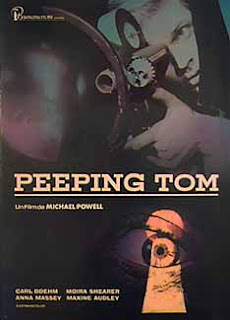
Once I'd decompressed a bit from my viewing of The Red Shoes, I saw that the night was still young and thought I'd see what else Netflix Watch Instantly had to offer. I decided on Peeping Tom (trailer), having heard about it somewhere recently, but not realizing until it started that it's actually by the same director as The Red Shoes, Michael Powell. Turns out Powell and his frequent collaborator, Emeric Pressburger, were more or less the twin titans of 1940s British cinema, turning in The Life and Death of Colonel Blimp, A Canterbury Tale, A Matter of Life and Death, and Black Narcissus, in addition to The Red Shoes. However, Powell was working solo by the time he made Peeping Tom, a film starkly different from The Red Shoes in virtually every respect but their quality and their theme of irresistable, tragic compulsion.

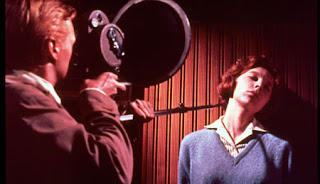
Mark (Carl Boehm) is a shy young film technician who always carries a hand-held camera and has an extensive filmmaking lab, screening apparatus, and collection of reels in his home. He's also a serial killer. His M.O. is murdering women with a blade attached to his camera's tripod leg, filming them while he does so and watching the films later. He becomes attached to Helen (Anna Massey), the young lady who lodges in Mark's house with her blind mother (Maxine Audley), but their budding relationship doesn't lessen his desperate need for voyeuristic violence, nor does the growing danger posed by the police investigation into his murders. (In fact, Mark displays the now-cliché behavior of the killer taking greater and greater risks out of apparent desire to be caught.)

While The Red Shoes revels in uplifting beauty and passion, Peeping Tom is sordid, unpleasant, and disturbing, especially for its time. (It apparently showed the first bare breast in mainstream British cinema.) Speaking of its time, it was released the same year, 1960, as another film by a British director about a psychologically disturbed but sympathetic serial killer of women, Psycho. While Psycho is more suspenseful and a greater overall filmmaking achievement than Peeping Tom is, the latter film is considerably more daring in how it depicts its killer. In Psycho, we think Norman is merely a dutiful son protecting his murderous mother until the climactic reveal, and the focus is usually on characters other than him (Marion, Sam, Lila, Arbogast). In Peeping Tom, however, we know from the beginning that Mark is the murderer, and he's in all but one or two scenes; the audience spends virtually the entire film following someone they know to be a serial killer.

Thematically, Peeping Tom obviously has a lot to say, beginning with Mark's symbolically loaded, if cumbersome, murder weapon. (No simple kitchen knife for Mark!) In addition to filming his victims, Mark mounts a mirror on his camera so that they see their own reflections as he kills them. So, in the darkened, quiet seclusion of his home theater (very much like a public theater), he watches these women watching themselves being murdered. And, of course, we both watch him watching them (adding another layer to the onion) and join him in watching them ourselves as though we're sitting there with him (making the audience an accomplice in his voyeurism, if not his violence directly). The role of Mark's camera is a pretty straightforward embodiment of the guilty thrill of witnessing violence (mediated and thereby dissociated from either danger to the viewer or real sympathy for the victim; "It's not real, it's just a movie"), but the role of the mirror is more complex and problematic. Mark explains that he's trying to capture the most perfect fear, the fear not of the violence itself but of their own fear, of the fear they see in their own reflections. Perhaps this is a comment on the filmmaker's manipulation of his audience in order to provoke emotional response and involvement, or on the audience's identification with what and who they see on film, or perhaps is a reiteration of the theme of the audience's reflexive involvement in, and thus partial responsibility for, what they see. (Probably all three, and even more that I didn't think of.) I think Scorsese was onto something when he said that the two essential films about filmmaking are 8 1/2 and Peeping Tom, Fellini exploring the exhuberant, life-affirming aspects of the art and Powell the sinister, transgressive, invasive aspects.

Another major element of Peeping Tom, and another it shares with Psycho, is male violence against women. Ever since these two "proto-slashers," women have been the primary victims of cinematic serial killers, and sex has been a major component. In Psycho, "Mrs. Bates" kills women to whom "Norman" is sexually attracted (attraction evidenced by his own "peeping tom" scene watching Marion throught a peep hole); in Peeping Tom, not only are all of Mark's victims women, but in the first scene he murders a prostitute, and in addition to his film-crew job he moonlights as a pornographic photographer. In one respect, this is just a reflection of the history, as old as humanity itself, of sexually motivated violence by men against women. Even relatively normal and sympathetic killers (in comparison to the more monstrous likes of Jason Voorhees, Michael Myers, and Leatherface) like Mark and Norman are depicted as socially isolated and emotionally stunted, with little romantic or sexual experience; desire becomes mingled with frustration and shame, and finds an outlet in violence against the objects of desire. Indeed, in Peeping Tom the themes of the dark sides of filmmaking and sexuality are both expressed in the word "object": Just as the camera creates a distance between filmer (and audience) and filmed, between subject and object, a distance and detachment necessary to kill a helpless, pleading victim, so too can sexual desire on the part of an emotionally immature (essentially adolescent) desirer result in seeing the desired simply as a thing to be selfishly enjoyed rather than as a fellow-person with her own life, wants, and fears. Both violence and pure sexual desire (that is, divorced from emotional involvement or empathy) involve a great deal of objectification, an effect essential to the mediating role of the camera.

Whew. I told you there was a lot going on in that film. I'll wrap this up by simply saying that I'd honestly never heard or been aware of Michael Powell prior to watching these two films, but that they were more than enough definitely to spur me to check out more of his and Pressburger's work in the future.

Sunday, December 5, 2010

Metamorphoses


As the screen completed its slow fade to white, and the words "Directed by Darren Aronofsky" appeared to start the closing credits, I was breathless, my mouth agape, my eyes as big as saucers, my heart racing. The previous hundred ten minutes—and particularly the last twenty or so—had been one of the most thrilling, moving, transcendent experiences I'd ever had watching a film. After having seen thousands of films in my life, I found myself astounded anew at what this medium is capable of achieving.

(And I'm not just talking about Natalie Portman and Mila Kunis's "scene together." Though that was certainly memorable in its own right.)

Black Swan (trailer) is the story of Nina (Portman), a talented ballerina in a New York ballet company, whose greatness is impaired by an almost childlike meekness and inexperience. However, the company's director, Thomas (Vincent Cassel), sees potential—and perhaps something else as well—in her, and chooses her for the lead in Swan Lake, requiring her to play both the pure, innocent heroine and her dark, seductive doppelgänger, the "black swan." The tremendous physical, mental, and artistic pressures that the role imposes as she prepares are compounded by the people around her: her encouraging but dominating and manipulative mother (Barbara Hershey), a ballerina herself before Nina's unexpected birth required her to give up her career; the retiring prima ballerina Beth (Winona Ryder), bitter over her seemingly premature sunset and the way the company—and Thomas in particular—used and then discarded her; and above all Lily (Kunis), a new arrival to the company whose uninhibited and passionate nature is exactly what Nina's "black swan" lacks, possibly both the key to getting Nina out of her artistic and personal shell and a ruthless rival trying to sabotage her big break. The strain of all this on the already fragile Nina takes a growing toll on her psyche, dragging her into paranoia, hallucination, and self-destruction.

Aronofsky's execution of this is fantastic. Portman's stunning performance is the best of her career. Her Nina begins seemingly in control, but only because never before seriously challenged; under her role's demands and Lily's influence, her brittleness becomes more and more apparent and threatens to shatter instead of strengthen her. (The role is funny because, like Nina, it is often said of Portman that, while very talented and attractive, she comes off as too sweet, delicate, and innocent to be really sexy, like a modern-day Audrey Hepburn. She's said that one reason she took the role was to try to shed some of that sweet-little-girl image and to be seen as more of a serious, adult actress.) Though pulling Nina in opposite directions, Kunis (whose performance won her the Mastroianni Award at Venice) and Hershey both nail the ambiguity their respective characters require, offering Nina comfort (in the latter's case) or liberation (in the former's) one minute and smilingly threatening her the next. Cassel has turned out to be one of my favorite actors this year, coming off his revelatory (to me, anyway) lead performance in the two-part crime-epic biopic Mesrine (trailer); here he not so much straddles the line between demanding mentor and exploitative scumbag as embraces both aspects of his character, accepting and exploring how they complement each other.

In addition to the cast, another aspect that stands out is the sound, and I don't just mean the Tchaikovsky. The incredibly demanding physicality of ballet is conveyed compellingly with the sounds of toes grinding on the floor like dull drills and clothes stretching and compressing as the dancers contort. Given that all this is usually drowned out by music during performances, actually hearing it during practice and rehearsals—no doubt accentuated for cinematic effect—gives an understanding of the great physical strain their bodies experience, while making visible and audible Nina's own psychological strain.

And speaking of physicality, Black Swan features enough cringe-inducing body horror to make Cronenberg proud. Not just the more fantastical transformations that Nina undergoes (of which the trailer offers a glimpse), but also the bodily damage resulting from the physical rigors of ballet and Nina's own increasingly high-strung nature: accidents from cutting finger- and toe-nails with scissors (which makes me uncomfortable regardless of the context), toe-nails breaking from pressure, nervous scratching and pulling at the skin around finger-nails. Though sometimes taken to gruesome extremes, this damage obviously results in far less harm or blood than your average horror film or thriller, but watching it did far more to ratchet up my tension, discomfort, and anxiety than most stabbings, gun shots, or beatings could. Though we never see much blood or gore, this film is not for the squeamish.

Regardless of its many art-house elements, Black Swan is, by genre, a thriller, like Aronofsky's debut, Pi; but it hews much more closely to the common themes and tropes of that genre, making it a more "thrillerish" thriller. The threats to Nina, even the ones only in her mind, are much more concrete than intellectual obsession; she comes to fear that people and forces are actually threatening her career and herself. This is where my only real criticisms of the film lie. (No, despite what all the praise above might suggest, I didn't think it was perfect.) Its faithfulness to familiar thriller tropes makes certain plot elements rather predictable: Of course the talented newcomer is going to be a rival and a threat to our heroine; of course the fading star whom she's replacing is going to be bitter and vindictive; of course the lights are going to go out and some blurred shape is going to rush past the end of the hall accompanied by a sudden, discordant crash on the score. I can't help but think the film could've forgone some of these "bump in the dark" moments and just let the tension come from Nina's more natural fears and disorientation; but this is a minor complaint for a film that does such a good job building a sense of threat, uncertainty, and loss of control. (Needless to say, it's handily unseated Argento's Suspiria (trailer) as the premier ballet-themed thriller featuring supernatural elements.)

Besides the film's artistic qualities, it also featured some core themes I found intriguing as well. One—probably the principal theme—is the idea of artistic creation through self-destruction. In order to play the "black swan" part of her role convincingly, Nina realizes that she must discard a good deal of who she is, the young, shy, inexperienced "white swan" who lives with her mother and has a bedroom full of stuffed animals. To achieve what the role demands, this butterfly must break out of her cocoon; but the process turns out to be a dangerous one, over which she has very incomplete control. She eventually begins to see positive results as her "black swan" performance improves, but what'll be left of her by the end as she lets go of her old life is uncertain. Before her stands the example—as both object of admiration and cautionary tale—of her predecessor as prima ballerina, Beth, whose great artistic highs went hand in hand with devastating personal lows. How far down Beth's road Nina will need to go is both a core element of the film's drama and a challenging question it poses about the creative process in general.

Another theme is that of the unreliable narrator. Though Nina doesn't literally narrate, we see the entire film through her eyes (I don't think there's a single scene without her), including her apparent hallucinations as her psyche breaks down. The subjectivity and unreliability of what we see is an obvious outcome of her psychological instability, but Aronofsky plays with this in interesting ways. For instance, Nina's hallucinations don't steadily become more dramatic and obvious; instead, obvious hallucinations are followed by events that seem plausible but on which doubt is later cast. ——— SPOILERS ——— For instance, obvious hallucinations like Nina's seeing her own face on a stranger, her mother's paintings screaming at her, and her growing wings during her "black swan" performance are interspersed with events like her sleeping with Lily, Beth's stabbing herself with her nail file, and Nina's killing Lily, which seem very real at the time but are later shown to be impossible or at least ambiguous. (Lily denies sleeping with Nina; Nina finds Beth's bloody nail file in her own hand after running away; and Lily turns up alive and well after Nina supposedly killed her.) ——— END SPOILERS ——— As a result, we begin to doubt (at least on first viewing) whether anything we're seeing, however plausible, is really happening or is merely in Nina's increasingly deranged mind.

Wow. There's so much more I could go on about: the captivating opening scene; Clint Mansell's haunting, operatic score; the grainy, heldheld-style photography (very like The Wrestler's) and its interesting contrast with the classical score and fantastical imagery; the camera's balletic movements around the actors. But I think I've written enough for now, to get my thoughts down while the experience is still fresh. Though not perfect—I'd have to rank it a little below The Fountain in Aronofsky's filmography, if only because a gorgeous time-skipping love story is a lot more pleasant to watch than Natalie Portman pulling at her cuticle until she tears it halfway down her finger—Black Swan is a gripping, intense, expertly crafted experience throughout, and in its conclusion rises to a beautiful, exhilirating euphoria rarely achieved by even the best. Perhaps it's just a matter of Aronofsky again shamelessly taking advantage of my well known weakness for pretty and emotive movies; even if so, he's done cinema a service in the process, and I couldn't be more grateful for it. You've triumphed again, Mr. Aronofsky.

P.S. — "I was perfect" is this year's "I think this just might be my masterpiece." Discuss amongst yourselves.

Thursday, July 29, 2010

A movie worth writing about


INCEPTION. This has been a long time coming, and I would like to say the time has been spent mulling over my thoughts. But, well, that would be a lie. Every time I open my Google Reader I see that it says there are two posts waiting for me to read and I feel guilty. So while waiting for Thirsty Thursday this week, I'll put some thoughts to proverbial paper. Keyboard I guess.

Having seen the movie (trailers) twice, I can say that those who say one has to see it more than once to "understand it" are either being what the kids call a "hater" or exaggerating. I got it for the most part the first time but there are certainly layers of meaning that come out after seeing it a second and -- what I hope will soon be -- third time. The first screening was mainly consumed with following the twists of plot and it was not until revisiting the move that I was able to appreciate the full extent of the scope of Christopher Nolan's filmmaking. Watching Memento in between, I found myself focusing on how well he had transitioned from a small-scale to a grand-scale director.

Inception has that complex storytelling packed full of nuance, metaphor, and layers of meaning found in movies generally relegated to small budgets and art-house theaters. But partly as a result of his commercially successful Batman franchise, Nolan has been given a studio budget and produces his movies in a way that reminds me of classic epics from the studio age where a director could fill the screen with his vision. From beginning to end, Inception is an immersive movie where the level of production value fills the screen with his vision. This is a movie that should properly be experienced on a large screen. In Memento we follow one character and use creative filmmaking to tell an individual story with the focus at all times on Leonard (Guy Pearce). For Inception the lead actor might be Leonardo DiCaprio, but party due to its ensemble cast, the real main focus is the world and the dreams. The characters are each more important for how they serve as our conduit into the understanding of Nolan's exploration of the concept of reality. More on why DiCaprio's Cobb is the most-developed character will have to wait.

I also got the sense of a more classic style of filmmaking in the actors chosen. DiCaprio might be a movie star but one known for using his post-Titanic career to position himself as a serious actor instead of a matinee idol. Start culling through the rest of the cast and you pull people known for providing strong performances in movies, not as btox-office draws. I get the sense that in making this movie Nolan pretty much said "I want a Joseph Gordon-Levitt-type actor" or an "Ellen Page-esque ingenue" and instead of trying to find someone to fit the bill, he got those actors. I have a running idea in my head that I go back to of who would be my dream ensemble if I were casting a movie (a topic I think worth making a post about, now that I think of it) and there's a sense I get that he did the same thing. And cast them.

Alright those are general ideas I can write about for those who are living under a rock and therefore not seen this movie. Now begins...

SPOILER ALERT

Now that is out of the way, the question is what I think the movie is about. As I discussed with you before, I do not think that the top -- his totem -- is going to fall. Although I have avoided reading analysis before writing this I did see one twitter post that made me think. Whoever it was wrote that it didn't matter if it fell or not because he was happy -- although it was written somewhat more eloquently. My reasoning for why it does not fall are somewhat related to that. The question of whether the whole movie is a dream is not something I will probably ever be able to tell for sure, although as I think of it again, I start to consider how much every character seems to act how he would expect -- specifically how certain he is of Ellen Page's reaction. Anyhow, that is for another post. The main idea I felt after coming out was that reality did not matter to him anymore and so his creation of his own world where he could be content is what mattered to him and so that's what he chose to do. Watching it more I think I'll be able to look more at the idea of how Nolan is exploring denial and how the idea of happiness itself is not an authentic but instead manufactured concept. Again, that might be for later.

The other part of the post that I couldn't really say before the spoiler cutoff is how much I admired the pacing of the movie. The movie holds suspense for roughly the last hour by cutting those different dreams together that are so different not just in atmosphere but also in the type of suspense created. From the idea of a falling van and a race against time and
an action-movie fight, we get a run of the different ways a movie can use its tools to keep an audience enthralled. Again, filmmaking on a grand scale. Nolan really shows in this movie how his ability as a small director and large-scale director can both be used at the same time.

Also, I think I might need to see the movie again. Soon. But there's my start to the discussion.


Monday, July 19, 2010

The Stuff That Dreams Are Made Of


I know that lately this blog has been neglected to the point that we should worry about hearing from Blog Protective Services, but it seems like it's been a while since I saw a film that really motivated me to throw my thoughts out into the electronic ether. Inception (trailers) is that film.

— YOU MUSTN'T BE AFRAID TO SPOIL A LITTLE BIGGER, DARLING. —

The first and foremost thing I have to say about Inception is: You see things you've never seen before. I don't mean that hyperbolically, but literally (unless you happen to have the imagination of a Fellini or an Arthur C. Clarke). The kind of sheer imagination on display in Inception is a rare and precious thing, especially in today's Hollywood and especially given the amount of resources usually necessary to pull it off convincingly. The city of Paris folding over onto itself; a freight train plowing down the middle of a busy city street; people fighting in a rotating hotel hallway; crumbling skyscrapers falling into the sea like a glacier. Even for these purely visual aspects of the film, to think that they all came from one imagination gives me even greater respect for Nolan—who both conceived of them as writer and executed them as director—that I had before.

In addition to the breathtaking visuals, the story itself is a marvel. For almost the entire running time—two and a half hours that flew by as quickly the second time seeing it as the first—it seemed that at least every ten minutes some new element entered the story that made me stop and think, "That's really cool," or "That really interesting," or "I can't wait to see where this will lead." Starting in the first fifteen minutes with using a dream within a dream to compound the subject's vulnerability, on through the use of totems, the dream-projections' violent reaction to dream invasion (and the extent to which anti-invasion training can take that, as seen once the team enters Fischer's subconscious), the differences in the perception of time between waking and dreaming (and its exponential multiplication as more dream-layers become involved), the necessity of a "kick" sensation to wake the dreamers, the revelation that the Mal who keeps appearing in dreams isn't an outside invader like the team but Cobb's own projection of his dead wife, Cobb's responsibility for her death and how that was done—Inception's story was so fascinating, so engaging, and so well and intricately constructed that it never gave my interest a chance to flag.

Just how well constructed this story is, just how much thought and care Nolan put into it over the decade or so he was working on it, is made particularly evident in the film's centerpiece, the team's invasion of Fischer's subconscious. Not only do they use three dream-layers to plant the idea deeply enough without his noticing, but each layer serves a particular purpose: the first (the rainy city) plays off the resentment Fischer feels toward his father; the second (the hotel) establishes distrust between Fischer and Browning; the third (the mountaintop hospital) creates the positive, emotional basis for the idea, the "catharsis." Eventually, all three layers are active simultaneously and affecting one another, seen most dramatically in the first layer's effects on the second, from the tumble-cycle hallway effect as the van flips over to the weightlessness created when Yusuf drives it off the bridge.

As we've already discussed, the various layers have distinct roles not only in the team's plan, but also in the narrative and drama of the film itself. In the first dream-layer, the van's slow (from the other layers' perspectives) fall toward the river below serves as the ticking clock against which everything else must race; in the second, Arthur must use both brawn to fight off subconscious security and brain to figure out how to create the kick necessary to awaken his sleeping teammates in a zero-gravity environment; the third is a classic action sequence with guns, explosions, and an army of faceless bad guys; in the fourth, limbo, the drama and suspense are emotional rather than action-based, as Cobb must finally confront and overcome the destructive pain and guilt he feels about Mal. These four layers are simultaneously interwoven in a tour de force of stunningly effective storytelling and editing, a cinematic Swiss watch.

Of course, all these scenarios would be insufficient without interesting characters and talented actors, and Inception has both. DiCaprio's Dom Cobb joins the ranks of protagonists haunted by their past familiar from Nolan's filmography: Guy Pearce in Memento, Al Pacino in Insomnia, Hugh Jackman in The Prestige, and, the exemple par excellence, Christian Bale in the Batman franchise. Like them, Cobb is essentially a loner but is forced by necessity into uneasy alliances of convenience with others, imbuing him with an intriguing tension. The other members of the team are much more peripheral, but that doesn't mean they're one-dimensional or without color: the professional Arthur's longstanding but often tense working relationship with Cobb; Eames and Arthur's barbed exchanges; Ariadne (I see what you did there, Nolan!) as the simultaneously eager but cautious outsider, a role both giving an opportunity for explanatory exposition for the audience's sake and providing a fresh pair of eyes to perceive the damage and danger caused by Cobb's obsession with Mal; Saito acting both distantly first as target then as suspicious employer, and closely as an active member of the team. In addition to these, we get Batman alums Michael Caine and Cillian Murphy, as well as too-brief appearances by Pete Postlethwaite, Lukas Haas, and Tom Berenger (who's been AWOL from marquees too long, if I might be permitted a little Platoon reference). Though the amount of screen time some of them get is limited, they all come across as real, vibrant characters.

Inception was a joy to experience, and my hope is that its success will make it easier for similarly ambitious and visionary stories to get produced. I've already heard it described as the kind of film—like The Matrix over ten years ago, and Star Wars and the early Spielberg films twenty years before that—that will send kids to film school in the years to come, and I think the fact that it's so imaginative that it doesn't just put its creator's imagination on display, but also sparks its audience's imagination, makes that prediction a pretty likely one. We'll be fortunate if budding filmmakers find inspiration in Inception, with its creative vision, intelligence, thrilling action and suspence, moving drama, technical mastery, intriguing characters, and vast ambition. Inception is the cinematic total package.

P.S. — For this post's title, I was also considering "Beyond Your Wildest Dreams" and "Immaculate 'Inception,'" but I think you'll admit they're a bit over the top; and, after all, you can never go wrong with the potent combination of Hammett, Houston, and Bogie.

Saturday, March 6, 2010

War is hell, but it makes for good movies

THE HURT LOCKER. So in keeping with my attempt to catch myself up this will again be somewhat short. I ended up seeing the movie (trailer) on a whim as it was playing at the AFI theater, which is essentially one bus stop after the one I get off at and I decided just before pulling up outside the apartment complex to go on up and watch the movie.

First off I should say I find movies that revolve around war appealing as the topic is pretty inherently dramatic. I also think the title of the movie is quite good with the idea of "hurt" being used not just to describe a creation of pain but also in common, especially military usage, to speak of using violence.

It is certainly an odd movie to peg and one that I think reminds me of our earlier discussion of the concept of genre and this is certainly a movie that leaves one questioning how it fits in. On one hand there is certainly an action-movie aspect to the film with a number of truly intense situations featuring the bad-ass character that like those Bruce Willis has made a career out of playing. In this case we get Jeremy Renner (a previously underrated actor) as Sergeant William James, a bomb technician in the Iraq war whose job is to defuse IEDs and takes a particular risky (and, as is the case in an action movie, effective) approach to his job. But the tropes of the genre break down quickly with the lack of a true dramatic event to allow our protagonist to shine and win the day. Instead director Kathryn Bigelow leaves us with the monotony of what James does and allows the viewer question the worth of his sense of duty and daring, an outcome rarely seen in an action movie.

I was reading a somewhat unrelated article on Slate this past week that referred to The Hurt Locker, stating that "despite its visceral view of war as madness and addiction, [it] has been pegged as an Iraq war movie that has nothing to say about the Iraq war: action cinema unencumbered by politics." It seems to me that it takes a bit of a turn there to which I do not completely concur with what the author states is the conventional wisdom. For the most part The Hurt Locker is a character study of a hardened man that one might have seen in a Scorcese-De Niro movie of the 1970s but dropped in the Iraq war. Furthermore to say it has nothing to say about the war is quite off base. There have been a number of movies made about the current conflict and none have done particularly well with audiences of critics (a topic I broached before) and this has been heralded as the first noteworthy film made about the war. The reason it has acheived this recognition is because it has avoided the heavy-handed morality most Iraq movies thus far have utilized. It is not a "political" film by any stretch of the imagination, but the blunt and realistic way it presents the danger and futility of the war says a lot about what this war is and allows the viewer to draw conclusions, a conclusion taken even further by a veteran in a NYT op-ed piece likening it and The Messenger to a public service. Bigelow does not tell me I should come out of the movie angry about how nothing was accomplished by anyone in the movie, but I still came out thinking it. It is not that the movie has nothing to say about Iraq; it is more accurate to say it does not tell me what I should think about Iraq.

Aside from that, from a technical standpoint it was also a pretty great experience. The atmosphere really felt like a war zone (albeit to someone who has never been in one) and not something that had been prettied up for the cameras. It was raw and not very pretty, much like I imagine this war to be. At times I found myself wondering how Bigelow accomplished this with so many extras -- including whaling women -- who appeared to be somewhat authentic locals as opposed to, say, Italians in costume. Bigelow has a good chance of becoming the first woman to win a best director Oscar and her masterful handling of those tense sequences that manage to be tightly edited yet keep the situation lasting more than just through the quick jump-cut sequences of a Jason Bourne movie. There is a sustained tension through her scenes. Again she is using her craft to say something about the Iraq war without having tell us what she is saying.

Overall I think it turned out to be a pretty spot-on movie and I would enjoy seeing her unseat her ex-husband from his place as the king of the world at this year's Oscars.