A formerly cross-continental & cross-apartmental, now cross-town discussion on film featuring Owen and Matt

Showing posts with label action. Show all posts

Tuesday, May 3, 2011

Fast Five: Great Movie or Greatest Movie?


Thank you, "Anonymous," for the post title suggestion in your comment to my last post. I guess all those residuals you get from Primary Colors give you enough free time to browse and comment on obscure movie blogs. Well, it's appreciated.

So, in an O&MTM first, I'm going to step aside and give the stage to a guest-poster, "M," who recently made some interesting points in a spirited e-mail exchange with a friend of ours, "C," and myself. The topic was the latest installment in the Fast and the Furious saga, Fast Five.

* * * SPOILERS FOR THE F&F FRANCHISE IN GENERAL AND FAST FIVE IN PARTICULAR—SO BUCKLE UP! (so bad, I know) * * *


It started when "C" posed the following question:

"So.... Does Fast Five take place after 4 (Fast and Furious), but before 3 (Tokyo Drift)?
"4 was a prequel to 3 (right?) - and 5 comes right on the heels of 4 (breaking Dom out of prison). Then, at the end of 5, Han is taking the scenic route (through Europe) to Tokyo... where he eventually dies in a car explosion in 3.
"I guess it could also explain why Brian isn't in Tokyo.... because he's off somewhere raising little beach baby O'Connor.
"Then, Six (with Letty in Berlin) would probably also be pre-Tokyo.
"Does that make sense?"

To which I responded:

"I think you're giving it about an order of magnitude more thought than the filmmakers did."

To which "M" countered:

"Owen, I am going to have to disagree. I think what sets this movie apart is the level of thought that went into it. And Justin Lin, who cut his teeth on F&F:TD (and perfected his craft on my favorite Community episode) was just the man for the job. Drift was precisely the kind of movie you describe in your response - a franchise film that tries to get by on name alone while forsaking the universe it purports to be a part of and giving no thought to making a 'good' film. Lin was a hired gun on Drift - just as much a throw away as the movie itself. However, although the film was a failed money grab, Lin was able to showcase his technical prowess by bring a realistic depiction of extreme drifting to an international audience. Although the plot fell flat, people were awed by the money shots.
"Lin's flair allowed him to get a shot at making a true F&F movie in Fast and Furious. The principals were back and the movie was a success because he had more creative control and was able to consider what fans really wanted from the reunion of the perpetual buster, Paul Walker, and il padre di famiglia, Vinny D. Lin's enthusiasm (and the unabashed childlike wonder of Paul Walker) bled off the screen and was so infectious that it revitalized a franchise that nobody else even knew they wanted or cared about. Drift and FandF were strikingly different in that one existed squarely within the F&F universe and in the other, the producers were content to live on the periphery. Lin made people believe that this was a movie that they had been clamoring for even though, prior to seeing it, most of us were content to let F&F die.
"With Fast Five, Lin was able to immerse himself even further in the F&F universe. He was so deep that he took for granted the familiarity of the audience with his labor of love. If anything, too much thought was put into this movie, to the point that some of the basic premise was presented without much explanation. Lin's love of the characters, the subject matter, and even the audience is apparent throughout the movie. The cohension that this film has with the 4 other films is what made us love it so very much. And to keep that type of cohension across 5 films of various levels of quality and audience acceptance is something that, I would think, takes a great deal of thought.
"['C'] is right - In the end of Fast Five, Han was making his way to Tokyo, a trip that would end in his demise. Chronologically, Drift is the last film."


Man, have I been put in my place. Touché, good sir. Of course, my estimation of how much thought went into the franchise's continuity had no bearing on my enjoyment of Fast Five, which I expect was apparent after we all saw it a couple nights ago. It probably has more to do with the fact that I haven't caught any of the installments between the original and the latest, a knowledge gap of ten years and three films; I just had no appreciation of the intricate universe that had been constructed over the course of the franchise.

As for my own thoughts, it was a mindless summer action flick of the highest caliber. They finally found a worthy adversary for Vin Diesel in the Rock—worthy in the sense of visually seeming like a peer, someone who could go toe to toe with that trunk-necked behemoth, a true yin to his yang, much more so than the relatively puny Walker. (I certainly didn't mean "worthy" in terms of charisma—the true measure of an actor's performance in a film like this, rather than actual acting ability—in which respect the Rock easily runs circles around Diesel. Of course, even Diesel is a veritable Will Smith compared to Walker, who has all the screen presence of a cardboard box that was left out in the rain. Seriously, he, Josh Hartnett, and Channing Tatum need to team up and form some League of Bland Actors; by their powers combined, they might be as entertaining as watching grass grow.) In terms of what I hoped for from a film like this, Fast Five delivered: terrific action, well shot and with great, reverberating sound; a fast-paced storyline with an appropriate tempo between high-energy and lower-energy sequences; and fun, memorable characters who play off one another well. Fast Five is the kind of guns-and-'splosions action movie we can only hope they'd all be like.

In closing, I would like to leave you with a few words that I have no doubt shall echo down through the æons to come whenever man's thoughts turn to the art and craft of the moving picture:

"Did he slap that ass, or did he grab it and hold onto it?"

Wednesday, March 23, 2011

12 Monkeyhog Day


Last week, some colleagues and I got an early look at Source Code (trailers), the sophomore effort from friend of the blog Duncan "Zowie Bowie" Jones, as well as an all-too-brief look at the man himself. First, the Jones appearance. Like a small, English Bigfoot caught in a grainy home movie out in the woods, he seemed to pass in front of our field of vision only long enough for us to wonder if what we were seeing was the real thing before he strode back behind the treeline. During the sighting, he seemed to be trying to lower expectations a bit among the Moon fans like us in the audience (sadly, too few in the free screening), telling us not to expect his second film to be all that similar to his terrific first. (Whether he meant in terms of its subject matter or its quality, he didn't specify.) After maybe forty-five seconds at the mic, Jones hurried off, leaving the lights to fall and his film to speak for itself.

Though Source Code certainly is different from Moon, and not as good, neither it nor Jones has anything to be ashamed of for what it is, which is a gripping, engaging, well-above-average action movie. Colter Stevens (Jake Gyllenhaal) abruptly comes to on a commuter train headed for Chicago, his last memory being piloting an Army helicopter in Afghanistan; he doesn't know where he is, what he's doing there, or why the stranger sitting across from him, Christina (Michelle Monaghan), seems to know him. After eight minutes, an explosion destroys the train, and Colter is now isolated in a small, dark room with few features other than a screen on which a militarily attired woman, Goodwin (Vera Farmiga), anxiously questions him about what he just saw. It's soon revealed to Colter that, using a technology called "the Source Code," his consciousness is being thrown into an alternate reality based on the last eight minutes of the life of one of the train passangers before he, Christina, and the other passangers were killed in a bombing, but an alternate reality that he can fully explore and affect. His involuntary mission is to discover who was behind the bombing in order to prevent other attacks predicted to follow; but he can only do this eight minutes at a time, reliving the last moments of a dead man's life over and over until he finds the truth.

The obvious point of comparison for Source Code is as an action/thriller Groundhog Day, but with our hero forced to relive the same eight minutes in order to prevent terrorist attacks, instead of forced to relive the same minor holiday in order to become a better person and get the girl. However, the film I was most reminded of was 12 Monkeys, in which a man from the near future is forced by a mysterious authority to travel back in time to gain intelligence about a past, seemingly inevitable catastrophe. (Hence the mangled compromise of this post's title.) Though Jones didn't write Source Code, it shares with Moon (which he did write) a ready willingness to borrow what it needs from other films, but with its own spin. (I already noted the influences of Silent Running, Solaris, Blade Runner, and 2001, to name a few, on Moon.) It uses a high-tech narrative device and action-movie setting to examine, like Ramis's and Gilliam's respective films, how inevitable or open-ended life actually is, whether we're in the driver's seat or the future is set in stone. Surprisingly heady stuff for a springtime actioner full of pretty faces.

Jones has openly described Source Code as a "one for them" film. (I believe the term he used was "director for hire.") But really, the only actual negativity I can direct at the film is relative, in comparison to the "one for me" Moon. Sure, Gyllenhaal, Monaghan, or Farmiga doesn't turn in anything like Sam Rockwell's extraordinary performance, possibly the best of his career; but everyone delivers solid work, especially Gyllenhaal with his character's blend of military professionalism and understandable frustration with the situation into which he's been forced. The story doesn't have the same surprises and thematic challenges, but it's still one of the most intelligent and compelling films of its kind that we've gotten in a while, and one that interweaves its intelligence with the action and suspence quite well, in both conception and execution. If this is Jones's "one for them" film, we should be so lucky as to have more like it during the rest of his career.

Saturday, November 20, 2010

From the Moon to the Earth


The trailer of Source Code, the next film by the terrific director, Ziggy Stardust progeny, and friend of the blog Duncan Jones, is now available. Though he's moved to slightly more terrestrial settings this time around, he's hardly eschewing the fantastical and heady concepts that Moon featured. The plot seems a good deal more action-and-suspence-oriented than his last film (though Moon was hardly lacking in tension, of course), but I have a hard time believing that those elements won't stay tied to the mind-bending concepts and moral dilemmas we've seen in his past work. As for the cast, Gyllenhaal has done some fantastic work over the past decade (Prince of Persia aside), from Donnie Darko to Brokeback Mountain to Zodiac, and I loved Monaghan in Kiss Kiss Bang Bang and Gone Baby Gone (in both playing a love interest who's more than just a love interest—which, incidentally, is the vibe I'm getting from her role in Source Code as well). Given that he got what I consider one of the best performances of his career out of Sam Rockwell for Moon, I've got no worries at all in that department. If the trailer's anything to go by, it looks like Jones is two for two in delivering films that make us think while keeping us on the edge of our seats.

Friday, October 8, 2010

Everybody must get Stone(d)


First off, I should explain that while the words in quotation marks in the first paragraph of my last post were intended to quote what you'd said after we watched the film, I intended the quotation marks around "happy ending" in the third paragraph as scare-quotes, not (for lack of a better word) quotation-quotes. I guess I could've made that clearer. (Though in your last post you did write that the ending seemed to avoid "something that could be perceived to have a negative message"; maybe there's a difference between that and a "happy ending," but I'm honestly not seeing it.)

Secondly, I think our disagreement about the ending of Platoon stems from the fact that we simply see what the film is about somewhat differently. I agree that Taylor's "education," the various points that the film conveys about war can do to people, is an important element. But I think that to see that as the film's only purpose is to see it too narrowly. Platoon's not just about Taylor's learning the "moral of the story," so to speak—"the primal nature that can exist," "becoming what you loathe," "the experience of war can make any man a killer,"* etc.—but more about his Vietnam experiences as a whole and how they shaped his young life. It makes sense that Stone would look at it this way, since the events are partly based on (or at least inspired by) his own experiences in the war, with Taylor in many respects standing in for Stone himself (who came from an upper-middle-class family, dropped out of Yale, and enlisted at the age of twenty-one for combat duty in Vietnam). Taylor's more than just a character in a story whose role is to move the narrative along and illustrate certain issues, or at least that's how I imagine Stone saw him when he made the film. After all, nearly two decades of his life had already passed since Stone had served in Vietnam, so it would be natural for him to spend a minute or two reflecting on his fictional soldier's post-Vietnam life.

Taylor isn't a mere cipher to convey the film's lessons, to serve a narrative purpose and then disappear; he's a broader embodiment of the Vietnam experiences of Stone and veterans like him, experiences that they carried off the battlefield and that shaped their post-war lives. Those experiences included saying goodbye to friends, returning to "the world," mourning the dead, and reflecting on what it all meant and how one should move forward with the rest of one's life. So I think that Stone intended the film's ending as a nod to those aspects of veterans' lives—indeed, to his own life. As a matter of fact, I think that it makes the film more "fulfilling," giving it a broader scope and meaning, rather than encapsulating the events we've just seen with an abrupt ending on the battlefield. Just because it isn't The Deer Hunter or Born on the Fourth of July doesn't mean it can't or shouldn't touch on post-war life in addition to depicting combat. (And besides, I have a hard time seeing a film that depicts an American N.C.O. as a homicidal psychopath, and most of the rest as brutal, cruel, or indifferent, as making much of an effort to pander to veterans.)

And such themes, issues, and messages aside, I stand by my assertion that ending the film as soon as Taylor kills Barnes would have been less stylistically and tonally appropriate than ending it as it does, which eases the audience out and offers a chance for reflection.

I should mention that my support for the ending doesn't mean that I think Platoon is flawless in all respects. My main criticism would be that it doesn't really convey Taylor's claim during the epilogic voice-over that he was "born of those two fathers," Sgts. Barnes and Elias, that they were "fighting for possession of his soul." Other than that line and an earlier one (in the scene when Taylor attacks Barnes in the tent) when Rhah reminds Taylor that he (Taylor) used to admire Barnes, he seems to be entirely on Elias's side throughout the film and disgusted with Barnes. Maybe there are cut scenes of Taylor looking up to or identifying with Barnes, I don't know, but in the cut we watched those two lines seem really out of place, obliquely hinting at an aspect of the film that we never actually see.

* On that point, we should remember that Sgt. Elias had been in Vietnam for three years and was an excellent soldier, but never lost his decency or humanity. So the moral deterioration that Stone generally depicts among the characters as a result of their war experiences isn't really universal or inevitable.

Tuesday, October 5, 2010

Casting the second (post on) Stone

In your recent post about my somewhat offhand comments about Platoon, I think you may have put words in my mouth a little bit. As a student of journalism I should scold you for putting quotes around words I never said. Who do you think you are, Aaron Sorkin?

Spoiler alert as well here folks, which should be obvious since this is a response to another spoiler-heavy post. But I imagine one can never be too safe about preventing the spoiling of a 24-year-old movie.

My feeling was not that the movie had a "happy ending" by any stretch of the imagination -- Taylor is shown clutching a grenade and contemplating suicide and then we watch helicopters en route to military hospitals depart from land being made into mass graves. My quibble was with what I called a sentimental ending. The only purpose that the last few minutes served to me was to show how Taylor had a lot of emotion on leaving Vietnam and it did not seem that was what the movie was about prior to that ending. I saw the movie as following Taylor's education as a man and discovering through war the primal nature that can exist. That scene with Barnes was so powerful because it was the end of his education: He does exactly what he loathed about the sergeant and discovered that no matter how much he thought he was better than Barnes, at heart the experience of war can make any man a killer. It was a powerful movie about how a man loses enough of himself to become a warrior, not how a man becomes sorrowful about war. What it came across as was Stone felt he had to make an ending that was a bit of a tribute to veterans more so than a fulfilling part of the movie.

The slightly half-baked idea I mentioned at the end of the movie may not have been exactly how the film should have ended. It did not need to be a Sopranos style closing. But I stand by my observation that Stone would have made a stronger finish had he made that scene the final one. Instead that last moments had the smell of something a studio usually tacks on to make a particular group (veterans in this case -- not that I think it was anti-veteran but that's a whole different subject) or Academy voters who do not like to see something that could be perceived to have a negative message.

Monday, September 27, 2010

Oliver's stones


— THE FIRST CASUALTY OF WAR IS SPOILERS. —

Matt, after watching Platoon a couple nights ago, you said that you didn't like how Oliver Stone ended the film; specifically, you said that the fact that we see Taylor (Charlie Sheen) being evacuated from the battlefield and saying goodbye to some of the survivors from his unit meant that Stone didn't have any "stones" (in the parlance of our times), and that film would have been much more "effective" if it had ended with Taylor shooting Sgt. Barnes (Tom Berenger). I disagreed at the time, but hadn't had the chance really to articulate why (beyond the fact that we wouldn't have gotten that great final epilogic voice-over). Now that I've had the chance to think about it a little, I'd like to explain why I think the right ending for Platoon is the ending it has.

Platoon is told in a realistic style, and its tone is reflective and mournful. You see this in its straightforward structure and visual style, in the voice-overs, and in the score. That being the case, it makes sense to follow Taylor off the battlefield, into the beginning of his post-Vietnam life, as he reflects on what the experiences we've just witnessed meant to him, easing the audience out of the film. Ending it with a sudden cut to black (or something like that) after he shoots Barnes would have been completely out of place in terms of the tone the film had established. Something like that would have been more fitting for a film like Natural Born Killers, with its much more stylized . . . well, style, and its shocking and aggressive tone. Ending the film that way would have had a jarring effect that the rest of the film just wasn't going for. (Of course, a lot of the events depicted are shocking and jarring, for instance Barnes's shooting of the Vietnamese woman, but the way they're depicted is not, in terms of editing and photography.) It would be much more in keeping with what would become Stone's signature visual and editing style in later films of his like The Doors, JFK, and the aforementioned Natural Born Killers, or with Kubrick's nearly contemporaneous Full Metal Jacket, which, from its opening shots of conscripts having their heads shaven to the strains of "Hello Vietnam," informs the audience of its more over-the-top and satirical tone. Ending Platoon as he did was perfectly in keeping with the seriousness and realism that Stone had spent the prior two hours establishing, and so was quite effective.

I certainly don't see the ending as a sign of Stone's chickening out by giving the audience a more upbeat ending than the ending you suggested. First off, it's not really much of a "happy ending": Most of the unit is dead (either from the North Vietnamese or the napalm bombing), we see bulldozers pushing mounds of corpses into mass graves, and our protagonist weeps as the voice-over talks about how he carried the war's emotional scars for the rest of his life. Moreover, we don't need those final scenes to know that Taylor was probably going to make it off the battlefield: He was obviously wounded badly enough to be hospitalized, but not so badly that he would die before U.S. troops found him (as they almost certainly would, since they'd beaten off the North Vietnamese assault (however pyrrhically) and would then search the battlefield for survivors and collect the dead). Even if the film had ended as you suggested, it wouldn't have been any more or less a "happy ending," except for its jarring emotional effect, which, as I explained above, would have been inappropriate.

In any number of other films, the ending you suggested would have been great. But it would have been tonally and stylistically out of place in Platoon.

Friday, August 13, 2010

Scott Pilgrim & the Infinite Awesome


This has been kind of a weak summer movie season. That's not to say it's been a complete disappointment—Toy Story 3, MacGruber, I Am Love, and The Other Guys were all good (for very different reasons), Iron Man 2 and Predators were fun, and I'm looking forward to seeing The Expendables in the very near future—but going in there were really only two films I could honestly say I was really excited about: I've already seen one of them three times, and I just saw the other for the first time less than an hour ago. I can now say with complete confidence that those two definitely make the rest of the summer worth it.

Having just finished (as of last night) the sixth and final volume of Bryan Lee O'Malley's Scott Pilgrim saga, "Scott Pilgrim's Finest Hour," and watched the great Edgar Wright's adaptation, I'm just astounded at what a perfect match these two artists, the graphic novelist and the filmmaker, are for each other. Both the Scott Pilgrim comics and Wright's work—Spaced, Shaun of the Dead, and Hot Fuzz—combine a high-energy, cartoony aesthetic with interesting, realistic, full-bodied characters and genuine, honest stories about those characters' search for meaning and connection in life. Scott Pilgrim, a goofy, well-meaning but immature young man clumsily, painfully feeling his way into adulthood, fits right in with Tim, Daisy, Shaun, and Danny. However, despite the similarities, Wright isn't just reciting O'Malley's story but telling his own, and isn't afraid to make the characters his own. Scott Pilgrim vs. the World is just as much an Edgar Wright film as it is a Bryan Lee O'Malley story.

— SCOTT PILGRIM'S PRECIOUS LITTLE SPOILERS (for both the comics and the film) —

That said, the film borrows very heavily from the comics, especially for its first two-thirds or so (covering roughly the first four volumes). During that part of the film, virtually every change Wright made was merely taking things out rather than adding his own material—though what's there, while originating with O'Malley, still bears Wright's distinct stamp. Despite how much from the comics Wright was able to cram into the film (without overdoing it or slowing down the pace), there are a number of elements that didn't make the cut: Ramona's glowing head, Knives Chau's father and Scott's old friend Lisa from vol. 4, most of the details about Scott's history with Kim and Envy (to which the film merely alludes), the trip to Honest Ed's in vol. 3, the recording of Sex Bob-omb's album, and Scott's battles with various robots in vol. 5. As the film progresses, though, it differs increasingly from the comics: Scott's battles against Roxy, the Katayanagi twins, and Gideon are very different, Envy's "weak point" behind her knees is transferred to Roxy, and Ramona's battle with Knives is moved from vol. 2 to the film's climax. I'm not really complaining or anything, it's just interesting to see the degree of faithfulness to the source material change over the course of the film.

Speaking (some more) of faithfulness to the source material, it's worth mentioning that the film was already in production before O'Malley finished the final volume (which was only released last month), so the two versions of the Scott Pilgrim saga's finale differ greatly. — ÜBER-SPOILAGE TO FOLLOW, OBVIOUSLY — What's interesting are the elements that the two versions share (but utilize in different ways): the NegaScott, the final showdown at the Chaos Theatre, Scott's death, his resurrection thanks to his 1-up. So there must have been some collaboration between O'Malley and Wright regarding these details. However, the overall "message" with which the story concludes differs significantly between O'Malley's version and Wright's. In vol. 6 of the comic, Scott comes to realize that the source of his immaturity is his unwillingness to address his past actions truthfully and learn from them; instead, he's always remembered his past in such a way that he's always the good guy and those he's hurt either were evil or weren't really hurt at all. Though alluded to throughout the series, it doesn't become explicit until Scott visits Kim in vol. 6, when she contrasts the reality of Simon Lee, her harmless high-school boyfriend Scott beat up to date her, with Scott's fantasized memory of a "villain" from whom he had to rescue her in vol. 2. By perpetually lionizing himself and demonizing or ignoring those he's hurt, he never had to change or improve; as Kim tells him, "if you keep forgetting your mistakes, you'll just keep making them again." That puts the entire premise of the series—"Scott Pilgrim vs. the World," the good guy forced to battle bad guys and win the day—into an entirely different light, as an expression of Scott's childish, selfish view of himself and the world. It's only when he owns up to his own failings that he's able finally to overcome Gideon and get another chance with Ramona. The film doesn't include this thematic element other than several references to Scott's being an irresponsible "heartbreaker" and his incredulity at this; instead, the lesson he learns is "self-respect," which involves his admitting to cheating on Knives with Ramona (and vice versa) but has more to do with his fighting his battles for his own reasons rather than just to win the girl. That's fine in itself, but it doesn't fit especially well with the failings we've seen Scott exhibit previously or with how he plans to go forward at the film's end; if anything, doing things for himself rather than others seemed to have been much the problem in his life, and in the end he still ends up winning the girl anyway. This doesn't really take away from the film, but it does make its conclusion a bit less meaningful and "earned" than the comic's. — BACK TO REGULAR SPOILAGE —

But what, you may be asking, about the film as its own beast, independent of O'Malley's comic? Pretty darn great. I'm already a substantial fan of Wright's work, and Scott Pilgrim fits right in: energetic, imaginative, hilarious, with real characters dealing with real issues. Though Scott isn't dramatically different from the kinds of characters Michael Cera generally plays, he isn't just channeling George Michael Bluth for the umpteenth time; Scott's much more of a spazzy slacker than the uptight, rather nebbish Bluth boy. Mary Elizabeth Winstead's Ramona is exactly the right melding of sexy, sympathethic, and cold, coming across, like O'Malley's Ramona, as multifaceted rather than schizophrenic. The rest of the cast is great too, especially Kieran Culkin as Wallace, Scott's gay room- and bed-mate. Strangely enough, while Sex Bob-omb frontman Stephen Stills mostly hangs in the background in the comics, I really liked him in the film (played by one Mark Webber). Each of the evil exes gets his (or her) moment to shine, except for the Katayanagi twins, though, to be fair, they don't make much of an impression in the comic either. My socks were thoroughly knocked off when the Vegan Police who showed up to exact vegan justice on Todd for his vegan transgressions were played by Tom Jane (who just wants his kids back!) and Clifton Collins (who just wants his testicle back!). (Funny, Jane appeared in an episode of Arrested Development with Cera, while Collins appeared in Mike Judge's Extract with AD alum Jason Bateman, so feel free to use that info the next time you're playing six degrees.) Since music is a pretty significant part of the story, it's a good thing that the original music composed for the film (by Beck, among others) happens to rock. And no mention of the film's music would be complete without saying how much it warmed my geeky little heart to hear samples from The Legend of Zelda, like mother's milk to one raised in bygone days on the NES.

Indeed, Scott Pilgrim vs. the World is awesome, surprising no-one.

Thursday, July 29, 2010

A movie worth writing about


INCEPTION. This has been a long time coming, and I would like to say the time has been spent mulling over my thoughts. But, well, that would be a lie. Every time I open my Google Reader I see that it says there are two posts waiting for me to read and I feel guilty. So while waiting for Thirsty Thursday this week, I'll put some thoughts to proverbial paper. Keyboard I guess.

Having seen the movie (trailers) twice, I can say that those who say one has to see it more than once to "understand it" are either being what the kids call a "hater" or exaggerating. I got it for the most part the first time but there are certainly layers of meaning that come out after seeing it a second and -- what I hope will soon be -- third time. The first screening was mainly consumed with following the twists of plot and it was not until revisiting the move that I was able to appreciate the full extent of the scope of Christopher Nolan's filmmaking. Watching Memento in between, I found myself focusing on how well he had transitioned from a small-scale to a grand-scale director.

Inception has that complex storytelling packed full of nuance, metaphor, and layers of meaning found in movies generally relegated to small budgets and art-house theaters. But partly as a result of his commercially successful Batman franchise, Nolan has been given a studio budget and produces his movies in a way that reminds me of classic epics from the studio age where a director could fill the screen with his vision. From beginning to end, Inception is an immersive movie where the level of production value fills the screen with his vision. This is a movie that should properly be experienced on a large screen. In Memento we follow one character and use creative filmmaking to tell an individual story with the focus at all times on Leonard (Guy Pearce). For Inception the lead actor might be Leonardo DiCaprio, but party due to its ensemble cast, the real main focus is the world and the dreams. The characters are each more important for how they serve as our conduit into the understanding of Nolan's exploration of the concept of reality. More on why DiCaprio's Cobb is the most-developed character will have to wait.

I also got the sense of a more classic style of filmmaking in the actors chosen. DiCaprio might be a movie star but one known for using his post-Titanic career to position himself as a serious actor instead of a matinee idol. Start culling through the rest of the cast and you pull people known for providing strong performances in movies, not as btox-office draws. I get the sense that in making this movie Nolan pretty much said "I want a Joseph Gordon-Levitt-type actor" or an "Ellen Page-esque ingenue" and instead of trying to find someone to fit the bill, he got those actors. I have a running idea in my head that I go back to of who would be my dream ensemble if I were casting a movie (a topic I think worth making a post about, now that I think of it) and there's a sense I get that he did the same thing. And cast them.

Alright those are general ideas I can write about for those who are living under a rock and therefore not seen this movie. Now begins...

SPOILER ALERT

Now that is out of the way, the question is what I think the movie is about. As I discussed with you before, I do not think that the top -- his totem -- is going to fall. Although I have avoided reading analysis before writing this I did see one twitter post that made me think. Whoever it was wrote that it didn't matter if it fell or not because he was happy -- although it was written somewhat more eloquently. My reasoning for why it does not fall are somewhat related to that. The question of whether the whole movie is a dream is not something I will probably ever be able to tell for sure, although as I think of it again, I start to consider how much every character seems to act how he would expect -- specifically how certain he is of Ellen Page's reaction. Anyhow, that is for another post. The main idea I felt after coming out was that reality did not matter to him anymore and so his creation of his own world where he could be content is what mattered to him and so that's what he chose to do. Watching it more I think I'll be able to look more at the idea of how Nolan is exploring denial and how the idea of happiness itself is not an authentic but instead manufactured concept. Again, that might be for later.

The other part of the post that I couldn't really say before the spoiler cutoff is how much I admired the pacing of the movie. The movie holds suspense for roughly the last hour by cutting those different dreams together that are so different not just in atmosphere but also in the type of suspense created. From the idea of a falling van and a race against time and
an action-movie fight, we get a run of the different ways a movie can use its tools to keep an audience enthralled. Again, filmmaking on a grand scale. Nolan really shows in this movie how his ability as a small director and large-scale director can both be used at the same time.

Also, I think I might need to see the movie again. Soon. But there's my start to the discussion.


Monday, July 19, 2010

The Stuff That Dreams Are Made Of


I know that lately this blog has been neglected to the point that we should worry about hearing from Blog Protective Services, but it seems like it's been a while since I saw a film that really motivated me to throw my thoughts out into the electronic ether. Inception (trailers) is that film.

— YOU MUSTN'T BE AFRAID TO SPOIL A LITTLE BIGGER, DARLING. —

The first and foremost thing I have to say about Inception is: You see things you've never seen before. I don't mean that hyperbolically, but literally (unless you happen to have the imagination of a Fellini or an Arthur C. Clarke). The kind of sheer imagination on display in Inception is a rare and precious thing, especially in today's Hollywood and especially given the amount of resources usually necessary to pull it off convincingly. The city of Paris folding over onto itself; a freight train plowing down the middle of a busy city street; people fighting in a rotating hotel hallway; crumbling skyscrapers falling into the sea like a glacier. Even for these purely visual aspects of the film, to think that they all came from one imagination gives me even greater respect for Nolan—who both conceived of them as writer and executed them as director—that I had before.

In addition to the breathtaking visuals, the story itself is a marvel. For almost the entire running time—two and a half hours that flew by as quickly the second time seeing it as the first—it seemed that at least every ten minutes some new element entered the story that made me stop and think, "That's really cool," or "That really interesting," or "I can't wait to see where this will lead." Starting in the first fifteen minutes with using a dream within a dream to compound the subject's vulnerability, on through the use of totems, the dream-projections' violent reaction to dream invasion (and the extent to which anti-invasion training can take that, as seen once the team enters Fischer's subconscious), the differences in the perception of time between waking and dreaming (and its exponential multiplication as more dream-layers become involved), the necessity of a "kick" sensation to wake the dreamers, the revelation that the Mal who keeps appearing in dreams isn't an outside invader like the team but Cobb's own projection of his dead wife, Cobb's responsibility for her death and how that was done—Inception's story was so fascinating, so engaging, and so well and intricately constructed that it never gave my interest a chance to flag.

Just how well constructed this story is, just how much thought and care Nolan put into it over the decade or so he was working on it, is made particularly evident in the film's centerpiece, the team's invasion of Fischer's subconscious. Not only do they use three dream-layers to plant the idea deeply enough without his noticing, but each layer serves a particular purpose: the first (the rainy city) plays off the resentment Fischer feels toward his father; the second (the hotel) establishes distrust between Fischer and Browning; the third (the mountaintop hospital) creates the positive, emotional basis for the idea, the "catharsis." Eventually, all three layers are active simultaneously and affecting one another, seen most dramatically in the first layer's effects on the second, from the tumble-cycle hallway effect as the van flips over to the weightlessness created when Yusuf drives it off the bridge.

As we've already discussed, the various layers have distinct roles not only in the team's plan, but also in the narrative and drama of the film itself. In the first dream-layer, the van's slow (from the other layers' perspectives) fall toward the river below serves as the ticking clock against which everything else must race; in the second, Arthur must use both brawn to fight off subconscious security and brain to figure out how to create the kick necessary to awaken his sleeping teammates in a zero-gravity environment; the third is a classic action sequence with guns, explosions, and an army of faceless bad guys; in the fourth, limbo, the drama and suspense are emotional rather than action-based, as Cobb must finally confront and overcome the destructive pain and guilt he feels about Mal. These four layers are simultaneously interwoven in a tour de force of stunningly effective storytelling and editing, a cinematic Swiss watch.

Of course, all these scenarios would be insufficient without interesting characters and talented actors, and Inception has both. DiCaprio's Dom Cobb joins the ranks of protagonists haunted by their past familiar from Nolan's filmography: Guy Pearce in Memento, Al Pacino in Insomnia, Hugh Jackman in The Prestige, and, the exemple par excellence, Christian Bale in the Batman franchise. Like them, Cobb is essentially a loner but is forced by necessity into uneasy alliances of convenience with others, imbuing him with an intriguing tension. The other members of the team are much more peripheral, but that doesn't mean they're one-dimensional or without color: the professional Arthur's longstanding but often tense working relationship with Cobb; Eames and Arthur's barbed exchanges; Ariadne (I see what you did there, Nolan!) as the simultaneously eager but cautious outsider, a role both giving an opportunity for explanatory exposition for the audience's sake and providing a fresh pair of eyes to perceive the damage and danger caused by Cobb's obsession with Mal; Saito acting both distantly first as target then as suspicious employer, and closely as an active member of the team. In addition to these, we get Batman alums Michael Caine and Cillian Murphy, as well as too-brief appearances by Pete Postlethwaite, Lukas Haas, and Tom Berenger (who's been AWOL from marquees too long, if I might be permitted a little Platoon reference). Though the amount of screen time some of them get is limited, they all come across as real, vibrant characters.

Inception was a joy to experience, and my hope is that its success will make it easier for similarly ambitious and visionary stories to get produced. I've already heard it described as the kind of film—like The Matrix over ten years ago, and Star Wars and the early Spielberg films twenty years before that—that will send kids to film school in the years to come, and I think the fact that it's so imaginative that it doesn't just put its creator's imagination on display, but also sparks its audience's imagination, makes that prediction a pretty likely one. We'll be fortunate if budding filmmakers find inspiration in Inception, with its creative vision, intelligence, thrilling action and suspence, moving drama, technical mastery, intriguing characters, and vast ambition. Inception is the cinematic total package.

P.S. — For this post's title, I was also considering "Beyond Your Wildest Dreams" and "Immaculate 'Inception,'" but I think you'll admit they're a bit over the top; and, after all, you can never go wrong with the potent combination of Hammett, Houston, and Bogie.

Thursday, April 1, 2010

The Origin of Batmanuel


Fooled you! Sorry if you were genuinely looking for a post about the origin of the character that Nestor Carbonell played on the short-lived live-action TV adaptation of The Tick. However, I'll do the next best thing and talk about the much-anticipated origin of Richard Alpert in "Ab Aeterno," as well as "Recon" and "The Package." So enough fooling around, and on to Lost.

"Recon," our first Sawyer-centric episode of the season, gives us a glimpse, in its flash-sideways, of perhaps the greatest cop-show-that-will-never-be of all time, Ford and Straume. It also shows us some interesting aspects of Sawyer's character and nature. As far as we know, everything about the lives/life of the original timeline's Sawyer and alterna-Sawyer was the same up to and including their/his parents' deaths. In the original timeline, this drives him into a life of, essentially, following in the footsteps of the man who destroyed his childhood as a con man; in the new timeline, it compels him to join the LAPD in order to take down con men (and women) and eventually to get to Anthony Cooper. Instead of being a born criminal, Sawyer—both of them—is teetering on the line between the law and crime, with some small event early on—apparently his writing the letter to "Mr. Sawyer," using Jacob's pen—nudging him toward channeling his feelings of hate and revenge one way or the other. During his date with the smoking-hot alterna-Charlotte, he even says that he realized this early on—"I got to a point in my life where I was either going to become a criminal or a cop."—and chose the law. No doubt that's why he can play a con man in his sting operations so well. (That opening scene was a terrific little play on our expectations. Also, did you notice that the woman alterna-Sawyer was stinging called him "dimples"? I guess Sawyer isn't the only one quick with the nicknames.) It also reflects original Sawyer's fifth-season role as "LaFleur," head of DHARMA security (ironically, conning his way into a position of authority and trust). In both timelines, Sawyer walks a fine line between the right and wrong sides of the law, jumping back and forth as the situation requires, giving yet another example on Lost of moral ambiguity, of a blurring of the line between detective work and conning, law and crime, good and evil.

As for the original-timeline scenes of "Recon," we get our first real look at the returned Charles Widmore and his armed Geek Squad (I wish I could claim credit for having thought of that) of Liz Lemon, that nerdy data guy on Jason Statham's crew in Paul W.S. Anderson's Death Race, and what I can only assume will prove to be a bunch of red shirts. Widmore seems to be anti-Loophole, but of course that doesn't necessarily mean he's pro-Jacob. (For one thing, there's an obvious contrast between science-oriented Widmore and the low-tech Others, e.g., keeping Loophole out through sonar pylons vs. lines of ash. Speaking of the pylons, does this mean that Widmore's joined forces with the Hanso Foundation, the folks in Ann Arbor behind the DHARMA Initiative?) I wouldn't put the murder of the Ajira survivors on Hydra Island past either Widmore or Loophole; both can be pretty ruthless when it comes to getting what the want, or even to merely tying up loose ends. Meanwhile, Sawyer seems to have reverted back to his looking-out-for-number-one con man mode from the first season, telling both Widmore and Loophole what they want to hear in order to get what he wants, i.e., off the Island. The plot thickens . . .

In the next episode, "Ab Aeterno," we take a break for the most part from both the Island goings-on and the flash-sideways timeline to delve into one of the great mysteries of the series, Richard Alpert, a.k.a. Ricardus, a.k.a. Ricardo. This episode both gives us a heaping pile of answers to long-standing questions, and a lot of great character and background material showing us what makes the Island's three most mysterious inhabitants tick. Richard doesn't age thanks to Jacob, because he was refused absolution from a crooked priest and was afraid of dying and going to Hell. He arrived on the Black Rock, which was cast inland in a huge storm, crashing into and breaking the Taweret statue. The Island (via its "unique energy," perhaps) keeps Loophole trapped there, preventing him from wrecking havoc upon the rest of the world. Jacob brings people (the Black Rock, the Others, Oceanic 815, maybe DHARMA and Desmond) to the Island to prove to Loophole mankind's essential worth (perhaps in order to "defuse" his evil should he ever escape the Island). But far from being a mere info-dump, "Ab Aeterno" gave us a real sense of the rivalry between Jacob and Loophole—they've been trying that knife trick for centuries!—and showed us that Richard's story is really a tragic one: a simple man lost in a strange new world, willing to kill to get back the woman he loves, a pawn in a game beyond his comprehension, cursed with eternal life and what seems like a doomed mission, spending lifetimes in service to a being only to find his master murdered and his life and effort rendered apparently meaningless. But Hurley's ghost-whispering at the end infuses the distraught Richard with new purpose, and I'm looking forward to seeing what he does with it.

In "The Package," we pick up both the original timeline and the new timeline after our hour with the immortal Canarian: Widmore and Loophole are parrying and thrusting back and forth, and we find out what led alterna-Jin to be in that freezer and what happened after Sayid found him in "Sundown." As was speculated earlier, Jin and Sun aren't married in the new timeline; and far from her leaving him, the trip to LA is their opportunity to run away together, beyond (so they think) her father and his boss's malevolent reach. Unfortunately, three of the characters we love to hate from the original timeline—Keamy, Omar, and Mikhail—are waiting at the other end to complete the set-up that Mr. Paik has arranged by sending Jin with payment for his own hit, which Sun couldn't replace (having closed her account). Sayid's Gun Kata ends up resolving most of this, but the episode ends with two elements which may be more examples of the original timeline influencing the new: alterna-Mikhail loses an eye, and Sun is pregnant. In the original timeline, she and Jin were only able to conceive on the Island (perhaps related to its healing properties), so that may explain why they don't have off-Island fertility problems in the new timeline, i.e., Jin and Sun's on-Island fertility "bled over" into the new timeline, where off-Island Jin and Sun should be infertile. Alas, their story ended on a hell of a cliffhanger, so we'll have to wait and see if they finally get the happiness in the new timeline that has evaded them in the original.

In the original timeline, Widmore's people nab Jin (keeping him in good old Room 23), apparently to get information about the Island's various energy pockets that Jin studied during his stint with DHARMA in the '70s (again, pointing to the energy being tied to keeping Loophole prisoner on the Island). Widmore gives us more vague references to what would happen if Loophole escaped—"Everyone we know and love would simply cease to be."—but it remains frustratingly unclear (assuming he's telling the truth in the first place). Loophole takes a trip back to Hydra Island for a parlay with Widmore. (When they were getting the outrigger ready, I was hoping this would be our explanation for the event last season, when Locke, Sawyer, and the other time-skippers were followed and fired upon while rowing from the old beach camp to the Orchid station ("The Little Prince"). Guess not. On second thought, it couldn't have been, since when the time-skippers found their outrigger at the beach camp the camp was abandoned, whereas at the moment Jack, Ben, Ilana, et alii are there.) Speaking of the beach camp dwellers, there was some nice character interactions in those scenes, and I like that they have a new sense of purpose thanks to Richard's return, but the whole thing with Sun's hitting her head while running from Loophole and losing the ability to speak (but not write) English seemed straight out of Gilligan's Island; they might as well have had a coconut fall on her head. Granted, it led to a nice scene of her and Jack talking on the beach, and perhaps there's a genuine medical explanation for it, but the whole scenario struck me as a real narm moment.

Meanwhile, on the submarine dock on Hydra Island, we get the dramatic return of Desmond David Hume (and with him, Mr. Motorboat himself, Henry Ian Cusick). This was great because it not only creates a nice parallel between the new timeline, where Jin's supposed delivery to Keamy is the "package," and the original, where Desmond himself is the "package" Widmore's brought to the Island (foreshadowed during Sawyer's visit to the sub in "Recon"), but also is long overdue, both for the character himself and for the great importance that he's supposed to have for how the rest of the series plays out.

P.S. — Just in case you needed a little more awesome in your life, this guy delivers the goods with a series of classy, minimalist posters for each episode of the first three seasons. I especially liked the ones for "Two for the Road" and "Flashes before Your Eyes."

Thursday, March 25, 2010

Awesome


'ô-sem

adjective

Origin: awe, from the Old Norse agi, "fright," + the suffix -some, from the Old English suffix -sum, related to sama, "same."

1. extremely impressive or daunting; inspiring great admiration, apprehension, or fear.

2. extremely good; excellent.

3.

Thursday, March 18, 2010

The Clint Eastwood Western


Having recently seen two of Clint Eastwood's most celebrated films—both directed by and starring him, both westerns, but a decade and a half apart—for the first time, I thought I might say a word or two about him as a filmmaker and about the films' places in the western genre.

Eastwood is best known for his westerns. (He's also known, of course, for his action/thriller films like the Dirty Harry series and his recent slew of excellent work behind the camera like Million Dollar Baby, Letters from Iwo Jima, and Changeling, but nothing in his career is as iconic as his westerns.) However, for most of his career the western was well past its peak in popularity. He came to fame in the mid-'60s with Leone's Man with No Name trilogy, but the genre was soon in decline, and Eastwood—along with others in the genre like Leone, Peckinpah, and Penn—had to adapt his westerns with the changing times and culture. Both The Outlaw Josey Wales and Unforgiven are classic examples of the "revisionist western," upsetting simple, long-held received wisdom in favor of a grimmer, more complex, and more "realistic" (obviously a problematic word) depiction.

— THERE GONNA BE SPOILERS AHEAD, I RECKON —

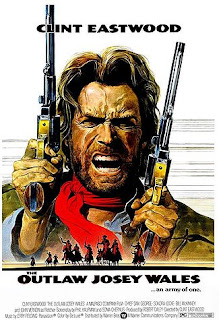
The Outlaw Josey Wales (trailer; I'm surprised Eastwood didn't sue the Army over that "army of one" slogan), released in 1976, starts giving us a different take on the western within the first five minutes, as Josey's wife and child are murdered by pro-Union guerrillas in Civil War Missouri, prompting him to join a rival pro-Confederate band that spends the war doing to Union sympathizers exactly what had been done to Josey. When all of his band but Josey surrender at war's end with the promise of amnesty, they're mowed down by the Union force accepting their surrender; the weapon used is what could be considered the symbol of revisionist westerns, the Gatling gun (also featured prominently in Django, Peckinpah's The Wild Bunch, and Leone's Duck, You Sucker!). Josey's sidekick for most of the film is an old Cherokee, who recalls the Trail of Tears and rues ever trusting the white man. Unlike in classic westerns, Eastwood has us rooting for an outlaw and an Indian against a troop of U.S. cavalry; added to this are Josey's guerrillas' attacks on pro-Union civilians during the opening credits and the anti-war message at the end ("I guess we all died a little in that damn war."). As a film, I enjoyed it well enough, but I wasn't quite sure how it had gotten its "classic" status (including preservation in the National Film Registry). One thing that didn't quite sit right was the inconsistency in tone, back and forth somewhat clumsily between somber (the beginning, the massacre of Josey's crew, the Comancheros, the final fight and aftermath) and light (scenes involving the Cherokee sidekick and the pioneer grandma, Josey's tobacco spitting, the folks at the saloon). But, as I said, overall I enjoyed it.

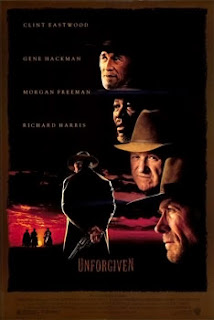
It's clear that Eastwood grew a lot as a filmmaker between 1976 and 1992, when he made Unforgiven (trailer). Its revisionism goes even deeper than The Outlaw Josey Wales's, questioning what's probably the fundamental element of the western genre, violence. Munny is a retired gunslinger with an exceptionally brutal past; though tamed for years by the love of his late wife, he takes one last job after some prostitutes put a price on the head of a john who cut up the face of one of them. Since settling down, Munny's tried his best to start a new, peaceful life, but events draw the monster back out of him. His adversary, Gene Hackman's Little Bill, is a particularly brutal sheriff, but his position—keeping hitmen from flooding his town—is more than understandable. There are no white or black hats here; everyone is some shade of gray.

Though there are some light elements like in The Outlaw Josey Wales, for instance Munny's difficulty in getting on his draft horse's back and the novelist who comes to town with English Bob, those are just a few brief glimpses of light through a generally somber tone. This is an Old West of indiscriminant killers, mutilated prostitutes, and dictatorial lawmen. The theme of dispelling the genre's illusions becomes express with the novelist, whose penny dreadfuls are the first wave of the romanticization of the West, further spreading the legends and lies already told by word of mouth about, for instance, Munny's and English Bob's gunslinging exploits, or the Schofield Kid's own exaggeration about killing the second hit mere seconds after the fact; as in The Man Who Shot Liberty Valance, "When the legend becomes fact, print the legend." While The Outlaw Josey Wales was good fun, Unforgiven is a real masterpiece; its violence is given gravity by the charm and humanity of characters like Morgan Freeman's Ned and the cut prostitute, and the pain and fear of the first hit as he bleeds to death in the dirt, whose only mistake was visiting a whorehouse with a short-tempered friend.

Eastwood's said that Unforgiven is his final western, and I can't think of a better one to end with, one that takes a hard, honest look at the genre and what it means. I think the western is America's national genre, for us what the samurai genre is for the Japanese (it's no coincidence that the two genres have informed each other for decades), and I'm very glad to see it reviving a bit in the last few years with such great examples as Brokeback Mountain, The Assassination of Jesse James, and No Country for Old Men, as well as TV series like Deadwood and Firefly. By giving the genre new stories to tell and new perspectives from which to tell them, the revisionism seen in Eastwood's westerns has only improved the genre and, hopefully, given it a new lease on artistic and entertainment life for generations to come.