A formerly cross-continental & cross-apartmental, now cross-town discussion on film featuring Owen and Matt

Showing posts with label suspense. Show all posts

Wednesday, March 2, 2011

Gettin' Hitched


I've been trying the past couple years to broaden my acquaintance with the filmography of Alfred Hitchcock beyond just watching Psycho over and over again. I've seen Vertigo, Rear Window, The Birds, and Notorious, and they, along with Psycho, are some of the best films I've ever seen in every respect: storytelling, technique, performances, suspense, and, let's not forget, humor. There's always some kind of comic aspect to be found somewhere in his films, from the matronly patron fretting over humane pesticide in Psycho to the rarely seen newlyweds in Rear Window. Not only does it provide some much-needed lightening of the mood and balancing of the tone, but it goes a long way toward humanizing the characters, making us care about them more, and thus fear for them more. But no film of his that I've seen has showcased Hitchcock's comedic side as much as The 39 Steps.

We're introduced to our dashing young Canadian hero, Richard Hannay (Robert Donat), in a London music hall where patrons test the encyclopedic knowledge of "Mr. Memory" with often absurd questions (including the old man who keeps trying to ask his question even after shots are fired and the audience stampedes). He finds himself with a beautiful spy calling herself "Annabella Smith" (Lucie Mannheim), who claims to be trying to keep aeronautical secrets from being passed to a foreign power. (Structurally the film mirrors itself, beginning with a music hall followed by Hannay in the company of a woman, and ending with Hanny in the company of a woman followed by a music hall.) Annabella is soon murdered, but not before telling Hannay cryptically of "the Thirty-nine Steps" (perhaps the MacGuffiniest of all MacGuffins) and a man whom she was supposed to meet in Scotland. Now wanted for Annabella's murder, Hannay travels to Scotland to try to get to the bottom of the conspiracy and thereby clear his own name.

One great way that Hitchcock maintains the suspense is by constantly shifting Hannay's environment and whom he's with: from the music hall to his apartment, to the train to Scotland, to the cottage of the pious crofter (definitely a Calvinist, he) and his long-suffering young Glaswegian wife—and sorry to nitpick, but it would take a wee bit more than an afternoon's hike to get from the Forth Bridge to what's clearly supposed to be the Highlands—to Ard-na-Shelloch, and so on. He—and the audience with him—remains uncertain where he'll find himself next, and who he can trust there. I also liked how Hitch upset expectations; the foreign-accented femme fatale who freely admits her mercenary outlook is trustworthy, while plenty of respectable-seeming natives turn out to be traitorous foreign agents or their unsuspecting pawns.

There are also some great little filmmaking techniques and tricks sprinkled throughout, like the first shots of Hannay at the music hall where we don't see his face, the scream of the woman discovering Annabella's body blended with the whistle of the train Hannay's riding as he makes his escape, or the camera going from looking in the window of a moving car to suddenly stopping and watching the car drive off. They don't necessarily make the film more suspenseful, but they definitely make it more interesting and fun to watch.

As I mentioned before, The 39 Steps is shot through with humor; in fact, it's easily as much a comedy as a thriller. In that respect, I have to say the film it reminds me of the most is Pineapple Express; Dale and Saul are similarly on the run from a murderous conspiracy, but there are so many laughs that you almost forget the mortal danger they're in. In The 39 Steps, there's the aforementioned scene at the music hall, then Hannay's interaction with the milk man, the "unmentionables" salesmen and the old vicar on the train, and the (comedically ingenious) scene at the election rally. Then, when Hannay meets up (again) with the bizarrely appareled Pamela (Madeleine Carroll), the film becomes a quasi-screwball comedy, with much sexual-tension-infused witty bickering between an attractive young man and woman who can't help but find themselves in one zany situation after another. Though humor and romantic relationships are staples of Hitchcock's thrillers, The 39 Steps is the only one I've seen in which they're so central (except maybe the romantic aspects of Vertigo and Notorious, but there isn't nearly as much comedy in those).

I'm reminded of a story someone (I don't remember who) told about sharing an elevator with Hitchcock. The two of them were alone in the elevator; then, when more people started getting on, Hitchcock started into the middle of describing a gruesome murder scene with great detail and relish. Soon the elevator stopped, the doors opened, and the eavesdropping fellow-passengers hesitated a moment before leaving, not wanting to miss the end of his lurid tale. When Hitchcock and the storyteller were again alone in the elevator, the latter anxiously asked what happened next; but, as Hitch explained, nothing happened next, he just made it up on the spot to amuse himself with everyone else's reactions. Hitchcock clearly saw a natural link between humor and fear, between comedy and tragedy, and so was never afraid to infuse some humor into his thrillers, which only improved them. That's nowhere more evident than in The 39 Steps.

Saturday, January 15, 2011

Shame and eternal shame, nothing but shame!


That's Shakespeare, ya philistines!

So while I was writing my post on Phantasm last night (another wild Friday night for Owen!), it dawned on me that, of the films I'd watched recently, the one I was writing about was a goofy, low-budget, late-'70s supernatural horror movie, rather than, respectively, one of the most beautiful and moving films I've ever seen and a groundbreaking, chilling, thematically complex and brilliant thriller. A profound sense of cinephilic shame came over me, and I knew I must do something to make amends. So here goes.

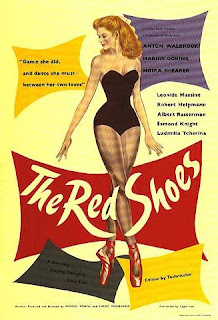
The Red Shoes (trailer) is a masterpiece in every conceivable way. It tells the story of Victoria Page (Moira Shearer), a beautiful, young ballerina who, as she herself says, lives to dance. She's taken on by Boris Lermontov (Anton Walbrook), the imperious head of an esteemed ballet company, who sees her potential to become one of the great dancers in the history of ballet, given the right training and motivation. But she soon meets Julian Craster (Marius Goring), the company's young and ambitious composer, and they fall in love; this enrages Lermontov, who fears that love will distract Page and hold her back creatively. Buffeted by ultimatums from Lermontov and Craster, Page finds herself in a love triangle, forced to choose between her life and her art.

First off, the film is breath-taking visually, Technicolor at its finest and most spectacular. The colors are luminous and crisp, and Shearer's bright red hair looks like it was made to be filmed with that particular process. The whole film is a visual wonder to behold, but this element becomes truly transcendent during the main ballet sequence, the performance of the ballet The Red Shoes, based on Hans Christian Andersen's fairy tale. Much like in Black Swan, the performance breaks the bonds of mere reality, as Page glides, leaps, and (literally) flies through a boundless environment of fantasy and pure emotion. Not to sound hyperbolic, but to me the ballet sequence is one of the greatest sequences committed to film, period.

Of course, the visuals aren't the only respect in which The Red Shoes is a triumph. The performances are uniformly excellent (assuming you don't have a problem with often melodramatic acting in a film about ballet), the drama is dynamic and stirring throughout, and its themes—above all the tragic strain of mutually exclusive but irresistable demands in one's life, in this case artistic creativity and romantic fulfilment—are profound and universal. I simply cannot recommend The Red Shoes enough. If you haven't seen it, see it immediately; if you have seen it, see it again.

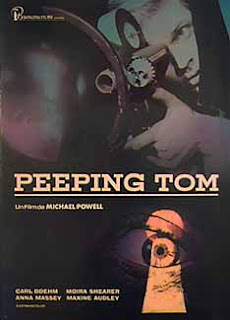
Once I'd decompressed a bit from my viewing of The Red Shoes, I saw that the night was still young and thought I'd see what else Netflix Watch Instantly had to offer. I decided on Peeping Tom (trailer), having heard about it somewhere recently, but not realizing until it started that it's actually by the same director as The Red Shoes, Michael Powell. Turns out Powell and his frequent collaborator, Emeric Pressburger, were more or less the twin titans of 1940s British cinema, turning in The Life and Death of Colonel Blimp, A Canterbury Tale, A Matter of Life and Death, and Black Narcissus, in addition to The Red Shoes. However, Powell was working solo by the time he made Peeping Tom, a film starkly different from The Red Shoes in virtually every respect but their quality and their theme of irresistable, tragic compulsion.

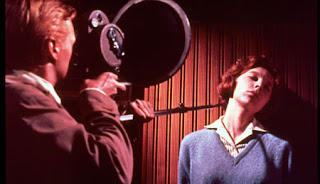
Mark (Carl Boehm) is a shy young film technician who always carries a hand-held camera and has an extensive filmmaking lab, screening apparatus, and collection of reels in his home. He's also a serial killer. His M.O. is murdering women with a blade attached to his camera's tripod leg, filming them while he does so and watching the films later. He becomes attached to Helen (Anna Massey), the young lady who lodges in Mark's house with her blind mother (Maxine Audley), but their budding relationship doesn't lessen his desperate need for voyeuristic violence, nor does the growing danger posed by the police investigation into his murders. (In fact, Mark displays the now-cliché behavior of the killer taking greater and greater risks out of apparent desire to be caught.)

While The Red Shoes revels in uplifting beauty and passion, Peeping Tom is sordid, unpleasant, and disturbing, especially for its time. (It apparently showed the first bare breast in mainstream British cinema.) Speaking of its time, it was released the same year, 1960, as another film by a British director about a psychologically disturbed but sympathetic serial killer of women, Psycho. While Psycho is more suspenseful and a greater overall filmmaking achievement than Peeping Tom is, the latter film is considerably more daring in how it depicts its killer. In Psycho, we think Norman is merely a dutiful son protecting his murderous mother until the climactic reveal, and the focus is usually on characters other than him (Marion, Sam, Lila, Arbogast). In Peeping Tom, however, we know from the beginning that Mark is the murderer, and he's in all but one or two scenes; the audience spends virtually the entire film following someone they know to be a serial killer.

Thematically, Peeping Tom obviously has a lot to say, beginning with Mark's symbolically loaded, if cumbersome, murder weapon. (No simple kitchen knife for Mark!) In addition to filming his victims, Mark mounts a mirror on his camera so that they see their own reflections as he kills them. So, in the darkened, quiet seclusion of his home theater (very much like a public theater), he watches these women watching themselves being murdered. And, of course, we both watch him watching them (adding another layer to the onion) and join him in watching them ourselves as though we're sitting there with him (making the audience an accomplice in his voyeurism, if not his violence directly). The role of Mark's camera is a pretty straightforward embodiment of the guilty thrill of witnessing violence (mediated and thereby dissociated from either danger to the viewer or real sympathy for the victim; "It's not real, it's just a movie"), but the role of the mirror is more complex and problematic. Mark explains that he's trying to capture the most perfect fear, the fear not of the violence itself but of their own fear, of the fear they see in their own reflections. Perhaps this is a comment on the filmmaker's manipulation of his audience in order to provoke emotional response and involvement, or on the audience's identification with what and who they see on film, or perhaps is a reiteration of the theme of the audience's reflexive involvement in, and thus partial responsibility for, what they see. (Probably all three, and even more that I didn't think of.) I think Scorsese was onto something when he said that the two essential films about filmmaking are 8 1/2 and Peeping Tom, Fellini exploring the exhuberant, life-affirming aspects of the art and Powell the sinister, transgressive, invasive aspects.

Another major element of Peeping Tom, and another it shares with Psycho, is male violence against women. Ever since these two "proto-slashers," women have been the primary victims of cinematic serial killers, and sex has been a major component. In Psycho, "Mrs. Bates" kills women to whom "Norman" is sexually attracted (attraction evidenced by his own "peeping tom" scene watching Marion throught a peep hole); in Peeping Tom, not only are all of Mark's victims women, but in the first scene he murders a prostitute, and in addition to his film-crew job he moonlights as a pornographic photographer. In one respect, this is just a reflection of the history, as old as humanity itself, of sexually motivated violence by men against women. Even relatively normal and sympathetic killers (in comparison to the more monstrous likes of Jason Voorhees, Michael Myers, and Leatherface) like Mark and Norman are depicted as socially isolated and emotionally stunted, with little romantic or sexual experience; desire becomes mingled with frustration and shame, and finds an outlet in violence against the objects of desire. Indeed, in Peeping Tom the themes of the dark sides of filmmaking and sexuality are both expressed in the word "object": Just as the camera creates a distance between filmer (and audience) and filmed, between subject and object, a distance and detachment necessary to kill a helpless, pleading victim, so too can sexual desire on the part of an emotionally immature (essentially adolescent) desirer result in seeing the desired simply as a thing to be selfishly enjoyed rather than as a fellow-person with her own life, wants, and fears. Both violence and pure sexual desire (that is, divorced from emotional involvement or empathy) involve a great deal of objectification, an effect essential to the mediating role of the camera.

Whew. I told you there was a lot going on in that film. I'll wrap this up by simply saying that I'd honestly never heard or been aware of Michael Powell prior to watching these two films, but that they were more than enough definitely to spur me to check out more of his and Pressburger's work in the future.

Monday, July 19, 2010

The Stuff That Dreams Are Made Of


I know that lately this blog has been neglected to the point that we should worry about hearing from Blog Protective Services, but it seems like it's been a while since I saw a film that really motivated me to throw my thoughts out into the electronic ether. Inception (trailers) is that film.

— YOU MUSTN'T BE AFRAID TO SPOIL A LITTLE BIGGER, DARLING. —

The first and foremost thing I have to say about Inception is: You see things you've never seen before. I don't mean that hyperbolically, but literally (unless you happen to have the imagination of a Fellini or an Arthur C. Clarke). The kind of sheer imagination on display in Inception is a rare and precious thing, especially in today's Hollywood and especially given the amount of resources usually necessary to pull it off convincingly. The city of Paris folding over onto itself; a freight train plowing down the middle of a busy city street; people fighting in a rotating hotel hallway; crumbling skyscrapers falling into the sea like a glacier. Even for these purely visual aspects of the film, to think that they all came from one imagination gives me even greater respect for Nolan—who both conceived of them as writer and executed them as director—that I had before.

In addition to the breathtaking visuals, the story itself is a marvel. For almost the entire running time—two and a half hours that flew by as quickly the second time seeing it as the first—it seemed that at least every ten minutes some new element entered the story that made me stop and think, "That's really cool," or "That really interesting," or "I can't wait to see where this will lead." Starting in the first fifteen minutes with using a dream within a dream to compound the subject's vulnerability, on through the use of totems, the dream-projections' violent reaction to dream invasion (and the extent to which anti-invasion training can take that, as seen once the team enters Fischer's subconscious), the differences in the perception of time between waking and dreaming (and its exponential multiplication as more dream-layers become involved), the necessity of a "kick" sensation to wake the dreamers, the revelation that the Mal who keeps appearing in dreams isn't an outside invader like the team but Cobb's own projection of his dead wife, Cobb's responsibility for her death and how that was done—Inception's story was so fascinating, so engaging, and so well and intricately constructed that it never gave my interest a chance to flag.

Just how well constructed this story is, just how much thought and care Nolan put into it over the decade or so he was working on it, is made particularly evident in the film's centerpiece, the team's invasion of Fischer's subconscious. Not only do they use three dream-layers to plant the idea deeply enough without his noticing, but each layer serves a particular purpose: the first (the rainy city) plays off the resentment Fischer feels toward his father; the second (the hotel) establishes distrust between Fischer and Browning; the third (the mountaintop hospital) creates the positive, emotional basis for the idea, the "catharsis." Eventually, all three layers are active simultaneously and affecting one another, seen most dramatically in the first layer's effects on the second, from the tumble-cycle hallway effect as the van flips over to the weightlessness created when Yusuf drives it off the bridge.

As we've already discussed, the various layers have distinct roles not only in the team's plan, but also in the narrative and drama of the film itself. In the first dream-layer, the van's slow (from the other layers' perspectives) fall toward the river below serves as the ticking clock against which everything else must race; in the second, Arthur must use both brawn to fight off subconscious security and brain to figure out how to create the kick necessary to awaken his sleeping teammates in a zero-gravity environment; the third is a classic action sequence with guns, explosions, and an army of faceless bad guys; in the fourth, limbo, the drama and suspense are emotional rather than action-based, as Cobb must finally confront and overcome the destructive pain and guilt he feels about Mal. These four layers are simultaneously interwoven in a tour de force of stunningly effective storytelling and editing, a cinematic Swiss watch.

Of course, all these scenarios would be insufficient without interesting characters and talented actors, and Inception has both. DiCaprio's Dom Cobb joins the ranks of protagonists haunted by their past familiar from Nolan's filmography: Guy Pearce in Memento, Al Pacino in Insomnia, Hugh Jackman in The Prestige, and, the exemple par excellence, Christian Bale in the Batman franchise. Like them, Cobb is essentially a loner but is forced by necessity into uneasy alliances of convenience with others, imbuing him with an intriguing tension. The other members of the team are much more peripheral, but that doesn't mean they're one-dimensional or without color: the professional Arthur's longstanding but often tense working relationship with Cobb; Eames and Arthur's barbed exchanges; Ariadne (I see what you did there, Nolan!) as the simultaneously eager but cautious outsider, a role both giving an opportunity for explanatory exposition for the audience's sake and providing a fresh pair of eyes to perceive the damage and danger caused by Cobb's obsession with Mal; Saito acting both distantly first as target then as suspicious employer, and closely as an active member of the team. In addition to these, we get Batman alums Michael Caine and Cillian Murphy, as well as too-brief appearances by Pete Postlethwaite, Lukas Haas, and Tom Berenger (who's been AWOL from marquees too long, if I might be permitted a little Platoon reference). Though the amount of screen time some of them get is limited, they all come across as real, vibrant characters.

Inception was a joy to experience, and my hope is that its success will make it easier for similarly ambitious and visionary stories to get produced. I've already heard it described as the kind of film—like The Matrix over ten years ago, and Star Wars and the early Spielberg films twenty years before that—that will send kids to film school in the years to come, and I think the fact that it's so imaginative that it doesn't just put its creator's imagination on display, but also sparks its audience's imagination, makes that prediction a pretty likely one. We'll be fortunate if budding filmmakers find inspiration in Inception, with its creative vision, intelligence, thrilling action and suspence, moving drama, technical mastery, intriguing characters, and vast ambition. Inception is the cinematic total package.

P.S. — For this post's title, I was also considering "Beyond Your Wildest Dreams" and "Immaculate 'Inception,'" but I think you'll admit they're a bit over the top; and, after all, you can never go wrong with the potent combination of Hammett, Houston, and Bogie.

Monday, June 8, 2009

Refighting the Revolutionary War


Or the War of 1812. Or the Trent Affair.

As I have seen neither State of Play, the British TV miniseries nor the American film, I obviously don't have much to say about them. I will make a couple comments. First, I'll probably see the miniseries at some point (it probably won't be that soon, though, considering how long my Netflix queue is already), if for no other reason than what looks like an incredible cast: Bill Nighy, Kelly Macdonald, James McAvoy, Polly Walker. (Afraid I don't recognize David Morrissey or John Simm.)

Also, I can't say I share your feelings about Russell Crowe. I'm not sure what you mean when you say that you find him "irritating." I agree that a lot of his films—A Beautiful Mind, Cinderella Man, A Good Year—are too sentimental and, as you said, "earnest," but I guess I just avoid those ones for the most part and go to his less Oscar-baiting films—L.A. ConfidentialMaster and Commander, 3:10 to Yuma, American Gangster. I'm not saying he's my favorite actor and I have pictures of him all over my room or anything, I'm just curious why you don't like him much.

The main thing I wanted to talk about, though, as you may have been able to tell from this post's title, is looking at the different ways that the same material is approached in British and American productions. There are innumerable examples of this phenomenon, going back to the first American production of Shakespeare; for every positive example, there have been more than a few negative examples, like Life on Mars, The Ladykillers, or McG's abortive remake of Spaced. Rather than dwell on those, I'll take a look at a couple relative successes, Traffic and The Office.

I haven't seen Traffik, the five-episode 1989 British miniseries on which Soderbergh's 2000 film Traffic is based, but, based on your description of the two versions of State of Play, it sounds like something similar took place with this British-to-American adaptation as well. Don't get me wrong, I think Traffic was a good film, I just see it falling into the "Big Issues" problem you mentioned. (Of course, for all I know the British miniseries did too.) While it does a good job of showing the complexity and interconnectedness involved in the drug-trafficking and drug-control systems, it also depicts some elements—especially in the Michael Douglas parts—in overly straightforward, message- or dilemma-driven terms. Douglas's character comes to believe that drug addiction needs to be dealt with through understanding rather than crack-downs; Benicio del Toro's character discovers the extent of the corruption in the Mexican war on drugs; Don Cheadle's character gets his man in the end, despite the murders of his partner and the prosecution's chief witness. While it makes for some entertaining storytelling, it presents things so straightforwardly that, like what you said about the American State of Play, it doesn't leave you with a lot to think about (other than, maybe, "Did she do the right thing?" with regard to Catherine Zeta-Jones's character).

Turning to another British-to-American adaptation, the American version of The Office is obviously very different from the British original. (I say "obviously" because I assume you've seen it, Matt. If you haven't, drop what you're doing and rectify that immediately.) Despite its superficial similarities to the original—the setting, the main characters, the faux-reality-show documentarian style—it takes a much simpler, sitcom-y approach. The clearest example of this is the shows' respective bosses, David Brent (Ricky Gervais) and Michael Scott (Steve Carell). Michael Scott is dorky, clueless, and generally incompetent, but his heart's usually in the right place, and the American series often gives him opportunties to demonstrate this. David Brent, on the other hand, has virtually no redeeming qualities, is almost uniformly selfish and inconsiderate, and when he's fired at the end of the second series I had a hard time not thinking "good riddance" (even though he was the funniest character, and his departure meant the end of the show). (He only redeems himself, slightly, at the end of the Christmas special.) As with Traffic, I don't mean to sound like I dislike the American version, it's actually one of my favorite shows; it's just that while it's a great sitcom, the original's a work of sheer genius, largely because of the harder edge the latter is willing to take with its boss character.

I can't help but think that a great deal of the difference between British television and American television—as can be seen most clearly in examples of direct adaptation like The Office—is due to structural differences as well as creative ones. A great number of British TV series aren't what we would think of as series, but as miniseries with only a limited number of episodes. Whereas American shows are usually open-ended stories of often two dozen or so episodes per season, made with the expectation of renewal for addition seasons, British shows (or at least the one's I'm familiar with) are made one series (i.e., season) at a time without expectation of renewal. (Even when they do get another series, it isn't always immediately; for example, there was a year-long hiatus between the first series (1999) and the second series (2001) of Spaced.) And each series is much shorter as well—six-episode series for The Office, seven- for Spaced—requiring much greater concision and economy of storytelling. This ends up meaning that British shows tend to have a lot less unnecessary fat than their American counterparts. Given the amount of story, characterization, and humor in the British Office, it still amazes me that it was all done in only twelve episodes and the two-part Christmas special. So, in comparison to American television, British television (at least the examples I've seen) tends to be much leaner and more carefully structured, since they can't afford to waste a single episode.

But in the end, I think we can all agree that Russell Crowe is too old to play Ben Affleck's college roommate, and that Ben Affleck is too Ben-Affleck-y to play a member of Congress.

Saturday, June 6, 2009

Play by Play

STATE OF PLAY. "STATE OF PLAY". With all this talk of Lost, I did get a bit distracted. I saw the movie from which this post arises (TRAILER) on my mom's birthday. Which is May 2.

I have a general policy of being, at best, cautious of anything staring Russell Crowe. It's not that he is an awful actor, it's just that, well, I find him irritating. And worse than that I find his choice of movies to be pretty pathetic and too often delve into earnestness, a trait that you might realize by now I despise in movies. In addition having been a reporter before, I know a bit about how things work and so am skeptical of movies about the profession, especially considering the corny scene from the trailer of Crowe's character bringing coffee to a detective and tricking him into giving information. I think that's probably an eye-roller for just about anyone, but it was cringe-worthy for me. But it was my mom's choice and, after all, it was cowritten by Tony Gilroy, whom I have written about as a pretty talented guy, and directed by Kevin Macdonald, who did The Last King of Scotland, which was an adequate movie, although honestly I appreciated it more for dramatizing the topic and giving an underappreciated Forest Whitaker the spotlight.

After writing most of this I realized I should do a quick, spoiler-free plot synopsis. Essentially in both stories the beautiful female aide to an up-and-coming politician dies under suspicious circumstances and a reporter, who has a history with the politician, investigates the story only to find it leads to a much larger web of political intrigue. Because it is a mystery, I probably should not say too much more.

The movie was OK and I would generally find it too unremarkeable to write about if it were not for the source material, a 2003 6-part British miniseries of the same name, and the opportunity to compare the UK and US approach to telling the same story -- which could be source of some fascinating conversation, I hope. So as not to have this go on forever, I am going to limit this post to be about this one individual case, but should you choose to respond, feel free to bring up others that might further explore the topic. I think you noted that you also were watching a British miniseries? Although I will admit I am less inclined to watch that movie treatment than this one so I don't blame you if you can't do the direct comparison.

The most telling contrast, for me, is the approach that the two take to showing the process of journalism. In the American version, Crowe's character (they kept the characters names so I'll generally stick to actors names for clarity) is proably 10 years or so older than the counterpart in the original and is presented as the grisly vetera who knows all the tricks of the trade. He drives around in his purposefuly beat up car and lives in a shabby apartment because, well, he's a reporter and that's what real reporters do! This despite the fact that he is a veteran reporter for a Washington Post stand-in and therefore would draw a rather healthy salary. His UK counterpart is played by John Simm as a bit of a smart-ass young gun who is in a bit over his head at times. In both treatments the main character seems to be unusually close to the editor of the paper, played by a steely Helen Mirren in the US version and a more caustic, and entertaining, Bill Nighy in the miniseries. Perhaps because I am familiar with an American-style newsroom, but I found the idea of Crowe just walking in and having chats with Mirren to be highly humorous. They do a good job on the set design of putting her separate from the rest of the newsroom, but where I've worked the editor is just as far from the newsgathering process. I would imagine it is the same at the Post and if I was the city editor there, I would be a bit pissed at being represented as a chubby guy whose only role in the development of a huge story is relaying messages from Crowe to Mirren. London newspapers are generally smaller and more controlled by the head editor so the relationship was not as odd to me, especially since Nighy is much tougher on Simm.

So am I picking nits because it's a topic in which I have some familiarity? Yes, probably so. But I think it does show the tendency of American film to frequently focus more on stars and out-of-this-world characters than our counterparts across the pond. We want people, not process. That's not always a bad thing and at times results in more personal stories instead of, at times, dull procedurals. But this is a story where the procedure is important. My biggest fault with the journalism in the movie is that all of these major forces come together in the space of a few days and, partly because Crowe is all-knowing, he is able to quickly find only the right information and in the space of a day he and his partner on the story, played by Rachel McAdams (more on this later), manage to go all over town collecting clues from various places in the space of a day against a ticking deadline clock. On the contrary the miniseries has plenty of blown deadlines that create an effective tension. Because it has much more time (6 hours instead of 2), it stretches the newsgathering over what I would guess are a couple of weeks and involves finding good information in bits and pieces followed by dead ends that later, once more clues come in, make more sense. There are lies and mistakes made and, at times, questionable professional and moral conduct. A story about figuring out a deeply political mystery involves a lot of procedure and although we do get to know the main characters well, what really shines is the depth of the story in this longer format. In addition to showing the lessened focus on character, it also says a lot to me about how the Brits consume their entertainment -- much more often in these series that run as long as needed to tell a story, as opposed to the US episode-centric television and action/suspense movies. It is quite fitting that a British miniseries would become an American movie.

Aside from the journalism, there is the subtext to the two pieces. Before watching the miniseries I read a piece in the NY Times (sorry, I can't find the article online) about the movie and the process of adapting it. It brought up the subject of class as a major part of the original so I will say that going into it I was looking for that. So the observation there is not completely my own. It is much more subdued than I was expecting and one has to be looking, I found, to see the references (although I would imagine a Londoner would find it much more obvious), but looking back it could be seen as a crux from which much of the true conflict revolves around. In the miniseries the reporter is an old employee (campaign manager) or the MP instead of an old college roommate to the senator in the American version (which, by the way, seems odd to me since Crowe looks A LOT older than Ben Affleck, who is not really worth writing much about). The film focuses more on the outside political influences invovled in the situation while the miniseries is more about the political process in general, which I found makes a bit more sense as the reveals begin to happen toward the end. The film also, in what appeared to be an attempt to be more contemporary, cast McAdams (whose does well if not admirable here) as the green blogger who, although smart, has a lot to learn from Crowe's old-school journalism. Aside from an overly simplistic (and outdated) representation of newspapers in a digital age, it also does a disservice by combining two characters -- the character with the same name as McAdams is played by Kelly Macdonald as more of an equal and her character brings up rather subtle issues of sexism, while the green character is a freelancer played by James McAvoy who seems to focus on generational issues and class again (he is the son of the editor). Overall there is a tension between the characters that doesn't seem to exist in the movie, which instead seems to want to have us look to topical issues of the problems in journalism and the military-industrial complex. We don't have class issues here to the extent of the Brits so it is not quite as easy to use as a backdrop, but despite being more focused on characters the movie revealed less and the interactions just did not work. It was as if they tried to bring over too much from the miniseries but tried to still tell it in an American way.

So what does this tell me? American films in general have a much more difficult time dealing with "big issues," mainly because it treats them as "Big Issues." The mniseries was not about the newspaper industry or the influence of the energy issues. It was about the power of the political system to corrupt and efforts of intrepid reporters to break into this system, something the main reporter had already failed to do once with the main politician -- who definitely does not view the reporter as an equal. The movie makes them old bros from college who had a fight but get back together to possibly solve the case and find the bad guys, all while journalism is changing because of the Web and new corporate owners (can't forget to have the Big Ideas). This makes the movie an OK piece of entertainment with some good turns that are not always predictable (athough for the most part, don't expect a lot of surprises) and seems to move along with a rather good rhythm. It's not bad filmmaking, it's just rather bland and did not make me think much at the end. The miniseris is a different beast and kept me wishing I had more time to watch another episode most nights and yet also contemplating what it all meant afterward -- even though I had seen it after the movie, which for the most part recycles the same main plot twists -- including as I write this several weeks later. I don't think those observations say something about every American film -- there are certainly many that are challenging -- but, in general, it says a lot about the difference between how the entertainment industry creates products for its audiences in the two countries.

Monday, March 23, 2009

To a deluxe apartment in the skyyyy


I pretty much agree with your last post, Matt, on the subject of genre. It's so fluid and hard to nail down that its usefulness is very limited. Not only are there many, many movies (and TV shows, books, songs, etc.) that contain elements "belonging" to more than one genre, but movies categorized within the same genre are often very different (I mean, the genre of "comedy" includes both Dr. Strangelove and Ace Ventura, for goodness sake). Genre isn't meaningful in itself, but only in terms of its effects on an audience through the expectations it raises.

SPOILERS!   SPOILERS!   SPOILERS!

ABANDON ALL HOPE OF AVOIDING SPOILERS, YE WHO ENTER HERE!

Ahem.

Now, there are countless examples of films that toy with those audience expectations in order to get certain reactions. For example, Psycho (trailer) starts out as a fairly standard Hitchcockian thriller about a young woman on the run after stealing from her boss; then, forty minutes or so in, she's brutally stabbed to death in the shower by—we eventually find out—a psychotic wearing his dead mother's clothes. We think we know what kind of movie we're getting, but then the rug is pulled out from under us; we don't know what genre we're in, so we don't know what to expect, heightening the suspense all the more. Another good example is No Country for Old Men (trailer), where we think we're getting a straightfoward, though very well made, good-guy-running-from-the-bad-guy movie, until toward the end when the good guy's killed by some random other guys chasing him, his wife is murdered senselessly, and the bad guy just disappears. Only then do we realize that the whole time we've been watching a completely different movie, not one about Josh Brolin on the run from Javier Bardem, but one about Tommy Lee Jones coming to terms with a changing world.

A recent film that predicates itself on toying with its audience's expectations about genre is Funny Games (trailer). An upper-middle-class family—Mom, Dad, Junior, and Fido—arrive at their shoreside vacation home and soon meet two clean-cut, impeccably polite young men who, over the course of the movie's two-hour running time—it feels much longer—taunt, beat, humiliate, and finally murder them. The film comes on the heels of the recent spate of "torture porn" movies—a genre I'm glad to say I've for the most part been able to avoid—but is a virtual shot-for-shot remake of the 1997 Austrian original, by the same screenwriter and director, Michael Haneke. Many of the marks of torture porn are present—prolonged terror and suffering, the torturers' complete control over the situation, the victims' being utterly outmatched and helpless, and rules and "games" devised by the torturers.

However, Funny Games deviates from the genre as much as it adheres to it. One of the torturers directly speaks to the audience occasionally, noting their role as co-participants in what's happening on screen; at one point he even basically says, "What's the matter? This is what you came to see, isn't it?" The two young men give different, contradictory explanations for why they're doing this, mocking the audience's expectation for a motive or "origin"; they even jump back and forth between different names. Things we naturally interpret as foreshadowing turn out to be dead ends; we see a knife left on the family's sailboat early on, but when the mother tries to use it toward the end to cut the ropes around her wrists, one of the young men sees this and throws the knife overboard. (I guess it's like Chekhov's literary maxim that if a story features a gun it must eventually be fired, except the gun misfires and that's the end of it.) The torturers' control is taken to an absurd degree when the mother manages to shoot one of them dead; the other just uses a remote control to rewind the movie a couple minutes and stop her from getting the gun. Whereas the victims in such movies are often unsympathetic in some way—for instance, the "slut" and "druggie" cannon fodder of classic slasher movies—our family is uniformly loving and relatable, which heightens the audience's feelings of revulsion at what happens to them. And instead of some kind of payoff or resolution, the plucky young son is the first to die, the father remains crippled and impotent and is never given a chance for heroism, and the mother is finally tossed off the sailboat to drown, almost as an afterthought.

Funny Games departs from the horror/suspense beats as a way of pointing out the formulas according to which these genres operate. By doing so, it emphasizes our place in all this by forcing us to engage with and question what we're seeing and our taste, under different circumstances, for similar depictions of terror and violence. Though certainly not an enjoyable film, it's a very interesting one and one that well illustrates how the subversion of genre expectations can in fact be the most effective use of them.

An excellent look at some of these issues can be found at Alternate Takes, "Some Thoughts on Safety, Danger, Dreams and Genre-worlds."