A formerly cross-continental & cross-apartmental, now cross-town discussion on film featuring Owen and Matt

Showing posts with label foreign. Show all posts

Saturday, January 15, 2011

Shame and eternal shame, nothing but shame!


That's Shakespeare, ya philistines!

So while I was writing my post on Phantasm last night (another wild Friday night for Owen!), it dawned on me that, of the films I'd watched recently, the one I was writing about was a goofy, low-budget, late-'70s supernatural horror movie, rather than, respectively, one of the most beautiful and moving films I've ever seen and a groundbreaking, chilling, thematically complex and brilliant thriller. A profound sense of cinephilic shame came over me, and I knew I must do something to make amends. So here goes.
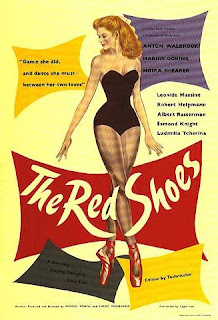
The Red Shoes (trailer) is a masterpiece in every conceivable way. It tells the story of Victoria Page (Moira Shearer), a beautiful, young ballerina who, as she herself says, lives to dance. She's taken on by Boris Lermontov (Anton Walbrook), the imperious head of an esteemed ballet company, who sees her potential to become one of the great dancers in the history of ballet, given the right training and motivation. But she soon meets Julian Craster (Marius Goring), the company's young and ambitious composer, and they fall in love; this enrages Lermontov, who fears that love will distract Page and hold her back creatively. Buffeted by ultimatums from Lermontov and Craster, Page finds herself in a love triangle, forced to choose between her life and her art.

First off, the film is breath-taking visually, Technicolor at its finest and most spectacular. The colors are luminous and crisp, and Shearer's bright red hair looks like it was made to be filmed with that particular process. The whole film is a visual wonder to behold, but this element becomes truly transcendent during the main ballet sequence, the performance of the ballet The Red Shoes, based on Hans Christian Andersen's fairy tale. Much like in Black Swan, the performance breaks the bonds of mere reality, as Page glides, leaps, and (literally) flies through a boundless environment of fantasy and pure emotion. Not to sound hyperbolic, but to me the ballet sequence is one of the greatest sequences committed to film, period.

Of course, the visuals aren't the only respect in which The Red Shoes is a triumph. The performances are uniformly excellent (assuming you don't have a problem with often melodramatic acting in a film about ballet), the drama is dynamic and stirring throughout, and its themes—above all the tragic strain of mutually exclusive but irresistable demands in one's life, in this case artistic creativity and romantic fulfilment—are profound and universal. I simply cannot recommend The Red Shoes enough. If you haven't seen it, see it immediately; if you have seen it, see it again.

Once I'd decompressed a bit from my viewing of The Red Shoes, I saw that the night was still young and thought I'd see what else Netflix Watch Instantly had to offer. I decided on Peeping Tom (trailer), having heard about it somewhere recently, but not realizing until it started that it's actually by the same director as The Red Shoes, Michael Powell. Turns out Powell and his frequent collaborator, Emeric Pressburger, were more or less the twin titans of 1940s British cinema, turning in The Life and Death of Colonel Blimp, A Canterbury Tale, A Matter of Life and Death, and Black Narcissus, in addition to The Red Shoes. However, Powell was working solo by the time he made Peeping Tom, a film starkly different from The Red Shoes in virtually every respect but their quality and their theme of irresistable, tragic compulsion.
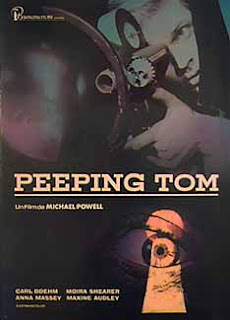
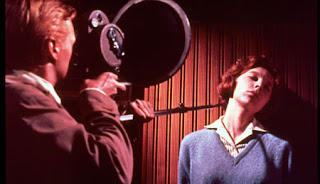
Mark (Carl Boehm) is a shy young film technician who always carries a hand-held camera and has an extensive filmmaking lab, screening apparatus, and collection of reels in his home. He's also a serial killer. His M.O. is murdering women with a blade attached to his camera's tripod leg, filming them while he does so and watching the films later. He becomes attached to Helen (Anna Massey), the young lady who lodges in Mark's house with her blind mother (Maxine Audley), but their budding relationship doesn't lessen his desperate need for voyeuristic violence, nor does the growing danger posed by the police investigation into his murders. (In fact, Mark displays the now-cliché behavior of the killer taking greater and greater risks out of apparent desire to be caught.)

While The Red Shoes revels in uplifting beauty and passion, Peeping Tom is sordid, unpleasant, and disturbing, especially for its time. (It apparently showed the first bare breast in mainstream British cinema.) Speaking of its time, it was released the same year, 1960, as another film by a British director about a psychologically disturbed but sympathetic serial killer of women, Psycho. While Psycho is more suspenseful and a greater overall filmmaking achievement than Peeping Tom is, the latter film is considerably more daring in how it depicts its killer. In Psycho, we think Norman is merely a dutiful son protecting his murderous mother until the climactic reveal, and the focus is usually on characters other than him (Marion, Sam, Lila, Arbogast). In Peeping Tom, however, we know from the beginning that Mark is the murderer, and he's in all but one or two scenes; the audience spends virtually the entire film following someone they know to be a serial killer.

Thematically, Peeping Tom obviously has a lot to say, beginning with Mark's symbolically loaded, if cumbersome, murder weapon. (No simple kitchen knife for Mark!) In addition to filming his victims, Mark mounts a mirror on his camera so that they see their own reflections as he kills them. So, in the darkened, quiet seclusion of his home theater (very much like a public theater), he watches these women watching themselves being murdered. And, of course, we both watch him watching them (adding another layer to the onion) and join him in watching them ourselves as though we're sitting there with him (making the audience an accomplice in his voyeurism, if not his violence directly). The role of Mark's camera is a pretty straightforward embodiment of the guilty thrill of witnessing violence (mediated and thereby dissociated from either danger to the viewer or real sympathy for the victim; "It's not real, it's just a movie"), but the role of the mirror is more complex and problematic. Mark explains that he's trying to capture the most perfect fear, the fear not of the violence itself but of their own fear, of the fear they see in their own reflections. Perhaps this is a comment on the filmmaker's manipulation of his audience in order to provoke emotional response and involvement, or on the audience's identification with what and who they see on film, or perhaps is a reiteration of the theme of the audience's reflexive involvement in, and thus partial responsibility for, what they see. (Probably all three, and even more that I didn't think of.) I think Scorsese was onto something when he said that the two essential films about filmmaking are 8 1/2 and Peeping Tom, Fellini exploring the exhuberant, life-affirming aspects of the art and Powell the sinister, transgressive, invasive aspects.
Another major element of Peeping Tom, and another it shares with Psycho, is male violence against women. Ever since these two "proto-slashers," women have been the primary victims of cinematic serial killers, and sex has been a major component. In Psycho, "Mrs. Bates" kills women to whom "Norman" is sexually attracted (attraction evidenced by his own "peeping tom" scene watching Marion throught a peep hole); in Peeping Tom, not only are all of Mark's victims women, but in the first scene he murders a prostitute, and in addition to his film-crew job he moonlights as a pornographic photographer. In one respect, this is just a reflection of the history, as old as humanity itself, of sexually motivated violence by men against women. Even relatively normal and sympathetic killers (in comparison to the more monstrous likes of Jason Voorhees, Michael Myers, and Leatherface) like Mark and Norman are depicted as socially isolated and emotionally stunted, with little romantic or sexual experience; desire becomes mingled with frustration and shame, and finds an outlet in violence against the objects of desire. Indeed, in Peeping Tom the themes of the dark sides of filmmaking and sexuality are both expressed in the word "object": Just as the camera creates a distance between filmer (and audience) and filmed, between subject and object, a distance and detachment necessary to kill a helpless, pleading victim, so too can sexual desire on the part of an emotionally immature (essentially adolescent) desirer result in seeing the desired simply as a thing to be selfishly enjoyed rather than as a fellow-person with her own life, wants, and fears. Both violence and pure sexual desire (that is, divorced from emotional involvement or empathy) involve a great deal of objectification, an effect essential to the mediating role of the camera.

Whew. I told you there was a lot going on in that film. I'll wrap this up by simply saying that I'd honestly never heard or been aware of Michael Powell prior to watching these two films, but that they were more than enough definitely to spur me to check out more of his and Pressburger's work in the future.

Saturday, February 27, 2010

You gotta keep the Devil way down in the hole


One is a beautiful, yet difficult and disturbing, black-and-white foreign film about strange events in a German village in the early twentieth century. The other is a gritty HBO series about crime, corruption, and culture in Baltimore in the early twenty-first century. They couldn't have less in common, right? (Other than the fact that I saw the former recently, and am watching the latter on DVD (currently beginning the fourth season).) Nevertheless, while watching The White Ribbon I couldn't help but be reminded of The Wire, noticing their shared thematic and structural elements.

(This post should lay to rest, gentle reader, any fears—or hopes—that this blog is going to be renamed "Owen and Matt Talk Lost," despite what recent posting activity might indicate.)

The White Ribbon (trailer), directed by Austrian filmmaker Michale Haneke (Funny Games (both the 1997 Austrian original and the 2008 American shot-for-shot remake), The Piano Teacher, Caché) and winner of the Palme d'Or at Cannes last year, depicts life in a quiet German village in 1913 and 1914, on the eve of the First World War. Despite the narration—from his perspective decades later in old age—by the young school teacher (Christian Friedel), the perspective is almost clinically observational (though its supposed objectivity is naturally problematic); he describes events simply and matter-of-factly, as if in a journal. Starting with the village doctor's being hurt when his horse trips over a wire tied between two trees near his house, strange and unexplained acts of violence and destruction begin occurring. However, these events, and the investigation into their causes, very much take a back seat to a depiction of the seemingly mundane lives of the villagers: farm work; religious services; children going to school, playing with one another, and interacting with their families; harvesttime festivities; the budding relationship between the school teacher and Eva (Leonie Benesch), the local landowner's young nanny. But once we get beneath the tranquil surface, we begin to see the hidden, darker side of this community, full of violence, fear, pettiness, cruelty, and selfishness, and the cause of the destructive acts becomes much more evident. It may occasionally not be very pleasurable to watch, but it is very fascinating and rewarding throughout.

The five seasons of The Wire, which ran on HBO from 2002 to 2008, are based on the experiences of former crime reporter David Simon and former policeman Ed Burns, who then fictionalized those experiences in creating a series that explores, from a variety of perspectives, the life, culture, and institutions of contemporary Baltimore. Though it primarily follows a group of city police officers, it's far, far more than just a police procedural: The cast comes to include the drug dealers and traffickers they're investigating, local politicians, junkies, union leaders, journalists, and public school administrators, teachers, and students. What's most refreshing about The Wire is that it doesn't seem to over-dramatize or "sex up" its subject matter. For example, when a special police detail is formed to investigate a local drug organization, far from being the elite squad you'd expect on other shows, at least half of its members are dead weight, officers merely looking to punch out at the end of the day, start collecting a pension in a few years, and maybe bust a few heads for kicks along the way. At every turn, the detail has to struggle against indifference, interference, and outright hostility from their superiors and colleagues; police politics is at least as great a challenge as the investigation itself.

What emerges through the cases the detail works on, the various people they deal with, and the lives they themselves lead, is a portrait of a community, one that in many ways is profoundly sick beneath its surface. While decay and despair in The White Ribbon's village are much less obvious than in The Wire's Baltimore, that really makes it all the more startling and disturbing once Haneke scratches the peaceful, well mannered, pious surface. While watching The White Ribbon, I couldn't help but think that Haneke was doing for that German village what Simon and Burns did for Baltimore: using a variety of characters, settings, and situations to dig into a community and see what makes it tick, and getting some pretty unsettling answers. Simon's community slowly decays from corruption, apathy, and failed institutions; Haneke's community is suddenly, seemingly inexplicably shaken as generations of repression, cruelty, and hypocrisy lash out.

Wednesday, October 7, 2009

Ø Brothers, Where Art Americanized Remakes?


On second thought and sober reflection, that's a really dumb post title. Oh well, it stays.

Though I haven't seen the original Danish version of Brothers (and my time machine's in the shop, so I haven't seen the American remake either), you raised some interesting points in your last post that I'd like to address.

To remake or not to remake. Whether 'tis nobler to introduce great stories from foreign films to wider American audiences, or just to say "No, sorry, sometimes watching a great work of cinema means having to read a little." It's kinda a tough call. My first instinct is to condemn remakes, updates, reboots, etc. and to encourage people to embrace the original instead, even if it's in another language, in black and white, or doesn't have any actors you recognize from the covers of People, Us Weekly, or Tiger Beat. But that would make me a hypocrite, wouldn't it, since only a couple posts ago I was gushing over a trio of great remakes. There have been plenty of good, even great, remakes of older foreign films, from The Departed, which you mentioned, to The Good Thief (based on Melville's Bob le Flambleur), Twelve Monkeys (based on La Jetée), A Fistful of Dollars (based on Kurosawa's Yojimbo), and, of course, Star Wars (based on The Hidden Fortress, also by Kurosawa). (Here is a handy list of English-language remakes of foreign films. Of course, this kind of influence is a two-way street; for example, two of Kurosawa's films, Throne of Blood and Ran, are based on Shakespeare, Macbeth and King Lear respectively.)

One particularly interesting example, discussed previously, is Funny Games, originally made in 1997 in German, remade in 2008 in English. Both were directed by Michael Haneke (who won the Palme d'Or at Cannes last spring for his most recent film, The White Ribbon), using the same script and all the same shots; the only differences were the actors and the language. I suppose Haneke did this to expose a wider audience to the ideas in the original; I doubt he was just trying to cash in on the American market, since there are a lot more audience-friendly stories out there if you're just trying to make a buck. Regardless of his motivation, it almost can't be considered a remake, since there's virtually no creative difference between it and the original; except for the actors' performances, you might as well be watching a dubbed version of the original.

The main reason why this issue is of interest to me is the forthcoming American remake of the 2008 Swedish film Let the Right One In (trailer), my number 2 film of that year. It has fantastic, understated performances, particularly on the parts of its child-leads, Kåre Hedebrant and Lina Leandersson; its cinematography and music create a beautiful, almost dreamlike atmosphere; and the story has a mixture of innocence, uncertainty, and fear that's particularly appropriate for a film about adolescence. Oh yeah, and it has a deathless minion of Hell damned to feed on the living for all eternity, so basically it's the total package. It's been out on DVD for a while now, and I would've bought it in a heart beat, but the English subtitles in the DVD version are significantly different, and vastly inferior, to those in the theatrical version. Why they would do that I have no idea, but it breaks my heart; I'm almost tempted just to learn enough Swedish to avoid the subtitles altogether. The North American distributer, Magnolia Films, has said it would release a version with the theatrical subtitles, but I haven't seen it yet. This isn't the first time I've been burnt by shoddy subtitles to the foreign films I love; I saw Park Chan-wook's Oldboy twice in theaters, and I'm positive the subtitles in my DVD are different. Seriously, this crap make me pull my hair out.

To get back on topic, the American remake is scheduled for release next year, with Matt Reeves (The Pallbearer (a David Schwimmer vehicle—I didn't even know there was such a thing), Felicity, Cloverfield . . . ugh) directing. Some casting news came out recently, with Kodi Smit-McPhee (soon to appear in the adaptation of The Road) and Chloë Moretz (recently in (500) Days of Summer, also in the upcoming adaptation of the comic book Kick-Ass) as the two kids and Richard Jenkins as the girl's "guardian." It's good to see they're keeping the kid characters young (Smit-McPhee is 13, Moretz 12) instead of going the more bankable, less squicky route of teen actors, as is Oscar-nominee Jenkins's involvement. There had previously been noises that Philip Seymour Hoffman would get that role, but I won't lose any sleep over Jenkins getting it instead. Hoffman would've captured the sad-sack-schlub aspect of the original's character (I'm imagining his roles in Happiness and Synecdoche, New York), but Jenkins can evoke a tired, forlorn quality (seen to such great effect last year in The Visitor) that I think would work great as well.

Though the casting seems promising, other elements—in addition to Reeves's filmography—are less so. First off, it may get a different title, "Let Me In" or "Fish Head." The former refers to a particular scene in the film, but in a slightly more obvious way than "Let the Right One In" does; as for "Fish Head," I haven't the slightest clue. Also, the original's director, Tomas Alfredson, made the good point that it doesn't make a lot to sense to remake what is already a fantastic film, especially so recently afterward. It threatens to distract from the original people who might otherwise see it, offering in its place a work that, even if as good as the original, is merely piggy-backing on its ideas.

In a move that may work for or against his film, Reeves apparently wants to hew more closely to John Lindqvist's novel. (Of course, he's already failing to do that by changing the setting from Sweden to the United States, isn't he?) I mention this because it's good to keep in mind when discussing remakes that the original film isn't always a canon from which any deviation is necessarily wrong; originals are themselves often based on their own source material, deviation from which may help or hurt them. So we'll have to see what impact that has.

Another reason the remake leaves a bad taste in my mouth is that it seems a bit like a cashing-in on the explosion of all things vampiric in popular culture right now. (A few years ago it was zombies, starting with Danny Boyle's 28 Days Later in 2002; the zombie renaissance seems to have mostly burnt itself out by this point, except for the occasional film like Zombieland that takes a slightly different approach from the well-worn "motley crew of survivors spend the running time killing the undead in gruesomely creative ways, most of them dying themselves along the way" template.) Since Stephanie Meyer's Twilight novels started making big bucks, it seems like you can't walk ten feet without seeing a new vampire-themed film or TV series, be it the films Twilight and New Moon, True Blood, Cirque du Freak: The Vampire's Assistant, Daybreakers, the inexplicable continuance of the Underworld franchise, etc., etc., etc. On the one hand, Reeves has some of the best source material—cinematic and (presumably) literary—that one could hope for; on the other, he is apparently going in a more "accessible" direction. As long as he doesn't have his young vampiress sparkling or playing baseball, I guess that'll be some kind of victory, at least.

Anyway, that's what I have to say about American remakes of foreign films (at least until I see either version of Brothers and can comment directly). I also agree that there doesn't seem to have been any high-quality films about the Afghan or Iraqi wars other than Kathryn Bigelow's outstanding The Hurt Locker this summer. I don't have a whole lot to say on this point; honestly, I think The Hurt Locker is the first I've seen because, well, the others weren't supposed to be that great. Maybe it's a matter of needing a little more distance from the subject matter, maybe it's just the fact that, regardless of subject matter, a lot more crappy movies are made than good ones. Keep in mind that it took a while for films like The Deer Hunter (1978), Coming Home (1978), Apocalypse Now (1979), Platoon (1986), and Full Metal Jacket (1987) to come out; prior to that, it had mostly been the Duke kicking VC ass in The Green Berets.

— — —

On an unrelated note, here are some great, insightful interviews with Stanley Kubrick, the tenth anniversary of whose death was last March. There's one each on A Clockwork Orange, Barry Lyndon, and The Shining. Enjoy!

Sunday, September 27, 2009

Brother, can you spare a remake?

Oh, blog...did you miss me? I realize that I have not been supportive and giving you the attention you so richly deserve for all the you have done for me, but I swear to God I haven’t been seeing any other online authoring tools. I mean I was moving and starting work at a different place and preparing for the LSAT -- yes, yes I'll stop -- I know they're just excuses and you deserve better. I just want you to know that it’s not you; it’s me. And if you just take me back, I swear I’ll make it up to you this time. I can change -- really I can. And no, those colors don't make your pages look fat.

Well, now that is out of the way so I can get back to the less important stuff....

BRØDRE (aka BROTHERS). Now give me some sympathy in my analysis here, please, because I did watch this about a month ago on the train as I was making my move to Washington. I do want to get this written to talk about not just the movie itself, which I did find noteworthy, but also the idea of American remakes of foreign films. So I'm going to start with the movie (trailer) first and then rip on Tobey Maguire and American film.

This Danish movie follows one of the oldest subjects in film: war. Like many such movies, especially those post-Vietnam, this one looks and the psychological affects of warfare both on the people serving and those that are left at home. As the title implies, there are two siblings in this telling, but unmentioned there is the one woman who is just as significant to the story and completes what because an uneasy triangle of family emotions and tension. Michael (Ulrich Thomsen) is the mature, elder brother who, as the movie commences, is preparing to be shipped off to Afghanistan and leave behind our female lead, his wife Sarah, who is played by the Danish actress Connie Nielsen. Interesting tidbit about her is that despite her background, she built her career in American movies such as Gladiator and Rushmore, with Brothers marking her Danish-language debut. The third major character is the flaky, younger brother Jannik (Nikolaj Lie Kaas) that grows closer to Sarah and her two daughters after Michael leaves. OK, so the trailer and everything about the movie I saw beforehand gives this plot point away, but it is a minor SPOILER ALERT, and if you don't want to know any more, skip to the end of the paragraph. Now that enough space should have passed for those not wanting to find anything out can leave, I will say that Jannik and Sarah become especially close as they both mourn Michael, who is incorrectly declared dead. This creates new complexity when Michael eventually returns home, especially with the raw wounds and possible PTSD (my diagnosis, not the film's) related to the events we see happen to him in Afghanistan. Giving away those events as well as how the story evolves would give away too much, but it is enough to say that everything becomes stretched toward the breaking point.

What I found worth writing about in this movie was the delicacy with which the director, Susanne Bier, handled her characters and situations that delve into much more dark, raw areas than we often see in film. Although war is not a new subject for film, she used a lot of the documentary-like methods used frequently in films of this generation to try and capture a realism of living those experiences. I don't necessarily mean the battle locations, but more the mundane, daily activities that one goes through as one tries to go one with a life that has been drastically altered by the absence of spouse or sibling. There are certain scenes in the movie that are longer than what one might expect and instead of cutting to the next shot, we often get a couple of seconds more of, say, Sarah's face that allows us to see not her instantaneous reaction, but how something settles into her visage. There is a lot of lingering -- mimicking, one might say, the way that Sarah's life is in a suspended state. About halfway through the movie there is a scene that I cannot describe in too much detail, but those who have or will see the movie likely know what I'm talking about when I say that one of the more dramatic shots goes on for an excruciatingly long period of time. It went on long enough for me to first think, "Gee, I think there should be a cut in here," and then eventually realize as it continued that by not cutting, the director was putting me in the head of the character and making it probably the most effective shot of the film. When it finally did cut, I found myself both mesmerized and horrified at the same time. Also, probably what the character felt.

I was also pleased to see the topic of Afghanistan -- a mission more closely tied to the United States than Europe but that has yet to yield a particularly memorable narrative film in this country. Perhaps that is why it has been remade as an American film and is being released this winter. Americans like a lot of the themes for war films brought up in this movie -- the idea of exploring the trauma at home hearkens back to Coming Home and the horror of war on combatants is, well, present in nearly every war film made since the 1970s. Having now seen this source material, it seems to me making an English-language movie 5 years later is a waste of time.

There was a time when remaking a foreign film made a lot of sense, at least from a financial standpoint, because a good plot was already in place and the state of foreign-film distribution was such that hardly anyone would have seen the original. But this movie was played in theaters on this continent and is easily available for rent with the diversified collection of services like Netflix. I do realize that just a few years ago Martin Scorsese won an Oscar for The Departed, which was a remake of a then four-year-old Hong Kong movie Mou gaan dou, known in the United States as Infernal Affairs. I do admit that case does work against my argument, but to a lesser extent because, having seen both movies, they are completely different film experiences. The general plot is the same but the style and character are reflect two vastly diverging approaches in the two tellings (and, I should say, they are both worth seeing). Having watched the trailer (see bottom) for the American remake of Brothers, it does not appear to be the case. The lines from the trailer mimic many of the lines from the movie and since the story is about a war that is still going on, I have a hard time seeing how the filmmakers will find something else to say about it. It looks like it will turn out to be a similar movie with the actors speaking in English instead. In defense of the movie I should note that it has some credentials that make it a more serious project than a simple Hollywoodization. The director is Irishman Jim Sheridan, who created such memorable films as My Left Foot, In the Name of the Father, In America and (as if that trilogy were not enough) the 50 Cent biopic Get Rich or Die Tryin'. With the aforementioned Tobey Maguire, Jake Gyllenhaal, and Natalie Portman, it shows some promise -- it just seems like a big ole waste of time. It's possible that with this team the movie might not be stripped of its quality and replaced by a weepy drama with Portman as the balling wife -- stripped of all her emotional scars and instead replaced by a teary housewife as American representation of women in movies often do. And since I did promise a complaint about Spider-man -- how about that he does not look noticeably older than Bubble Boy? Or that he looks just as small, if not smaller? The physical difference between the brothers I found to be a key element and when I see the two of them together it kind of ruins the dynamic.

It seems to me that too often, no matter who is involved, American remakes are known for taking what was a good foreign film and turning it into something bland. It seems that it would be quite difficult to make a good movie once, but to take the same idea and do it again without making it a completely unoriginal, literal translation would be even more difficult. Think Vanilla Sky, originally Abre Los Ojos, also with Penélope Cruz. It takes so much effort to make a movie and as you described in questioning whether Darren Aronofsky should remake RoboCop, I can't help but wonder if the talented people behind this movie should invest their time making something more worthwhile. There have been hardly any quality representations in narrative film of the two wars in which the country is now embroiled -- the first acknowledged success being The Hurt Locker, THIS YEAR -- that I would much rather see a creative team make another quality movie on the topic instead of rehashing one of the only good ones that has been done thus far. I would go so far as to say that film has failed thus far to capture the significance of the post-9/11 environment, which is at least as significant of a cultural element as the Vietnam War. But that could be a whole different post. This is just concluding that the topic of Afghanistan and modern war has not been so thoroughly explored that only opportunity is a remake of a foreign film.

So that does leave the question of whether I will see the new movie. Yes, I expect I will. If it is good, I will want to see what they have done with it and whether that causes me to reassess my judgment. If it is not good, well that just gives me something more to write about here.

-------

Trailer for the new movie be here...

Wednesday, August 19, 2009

Adaptation Discussion 2: The Revengening


I don't have a whole lot to say at the moment, but the film we watched last night, Alice (unofficial trailer) by Czech filmmaker Jan Svankmajer, got me thinking about a subject we discussed a while ago, namely the liberties filmmakers take when adapting either another work of fiction or historical events to film. The film begins by saying it's "inspired by" Lewis Carroll's Alice's Adventures in Wonderland, and in many regards it follows it—the White Rabbit running late, Alice growing and shrinking, tea with the Mad Hatter, flamingo croquet with the Queen of Hearts—but in many respects deviates from it, not only in its events but in its overall tone and mood, to the point that it's clear that Svankmajer felt no need to follow the source material when he didn't want to, presumably based on his own artistic choices and sensibilities. Alice is aesthetically much darker than Carroll's novel, and whereas much of the novel's appeal comes from its wordplay, the film is almost silent, and what dialogue there is is often repetitive. Svankmajer may have used Alice's Adventures in Wonderland as a jumping-off point, but he was obviously making his own film, not just adapting Carroll's novel.

This seems somewhat different from what we were discussing earlier, though, since that was about adapting historical events rather than existing fiction. While I generally think that filmmakers should tread carefully in the former case (e.g., Che, The Enigma of Kaspar Hauser, Battleship Potemkin), I don't necessarily think the same holds true for the latter. Whereas an historical adaptation has no clear, "canonical" text on which it's based and to which it can be compared for accuracy—even first-hand accounts aren't ironclad—an adaptation of fiction does have such a text—the original work of fiction—and so doesn't carry the same burden. I guess that's why I have no problem with the fact that Alice deviates greatly from its source material; Alice's Adventures in Wonderland is still there for anyone to refer to, so I think that Svankmajer, Tim Burton, Walt Disney, or anyone else doesn't bear the same responsibility (for lack of a better word) and is free to deviate from it however he sees fit.

So do you think that distinction is legitimate, between historical adaptations and fictional adaptations? Or do you think a film like Alice should stick more closely to its source material? That an adapter like Svankmajer owes something to the work he's adapting? Thoughts, feelings, reactions?

Thursday, June 25, 2009

Just a Little Bit of History Repeating

PERSEPOLIS

Whether the history will be Tehran in 1979 or Beijing in 1989 is still up in the air, however.

I have to confess, I haven't been following the recent events in Iran all that closely. I haven't really followed the news in general that much since moving to DC, since I haven't had a daily paper handy, and I've never been in the habit of poring over news or news-aggregating websites. Honestly, my main source of news is the "In the news" section of Wikipedia (my homepage), so I generally stay abreast of major events, but don't necessarily know every detail as it appears on CNN.com or The Huffington Post.

(The exception to this is when I'm in the news myself . . . or almost in the news, as was the case Monday with the DC train wreck. I was on my way home when it happened, only a couple stops away; I was heading the opposite direction, so luckily there was never any danger of my being on one of the trains that crashed. But I did have to sit on my train between stations for forty minutes or so, while they periodically told us there was an "electrical problem" up ahead. They finally took us back to the last station we passed and let us off, and I took a (very crowded) bus home. It wasn't a pleasant evening for sure, but I'm still counting my blessings considering what happened to a lot of other people.)

I have seen Persepolis (as you can see by perusing my Honorable Mentions of 2008), and I think it did a wonderful job of giving one person's ground-level view of major historical events. I also liked how the focus was almost solely on Marjane's life, of which the revolution was only one part; that ensured its human perspective rather than making it just an historical pageant. And I too loved the animation; while Pixar's been firing on all cylinders both artistically and narratively for almost fifteen years straight, it's nice to see some films buck the CG bandwagon, especially when they do so in a particularly abstracted and expressionistic (i.e., non-Disneyfied) way. I too have seen Waltz with Bashir and Linklater's Waking Life and A Scanner Darkly, all of them very good. (And if you like that style of animation, I'll make sure to show you some Frisky Dingo when you move here.) Also, on my Netflix queque (though currently in slot 85, so don't expect a review any time soon) is Azur and Asmar (trailer), a French CG children's film with such a distinctive and intriguing visual style that I have to check it out.

To add my two historical cents (as opposed to cinematic), frankly I'm astounded by how this revolution seems to parallel the one thirty years ago. In particular, the fact that the military seems to be largely sitting by the sidelines while the regime and the protesters vie for power. In 1979, the fact that the military didn't come to the Shah's defense spelt the end for his regime. But another lesson we should take from 1979 is that once a power vacuum is created, it isn't always filled by the people who did the leg work of removing the old regime (i.e., the liberals who'd been demonstrating against the Shah throughout the late '70s; similarly, it wasn't the Bolsheviks who brought the tsarist regime down in 1917, though they ended up being the beneficiaries).

I would say that I hope that things in Iran turn out well in the end, but I remember the line from Watchmen (in both the comic book and the film): "Nothing ends. Nothing ever ends."

Thursday, April 9, 2009

Proof positive of the breadth of my movie tastes


It looks like we're both pretty busy right now, but just to keep the blog active I thought I'd mention the last two movies I've seen, though I don't have a lot to say about them at the moment.

So last night I saw Once (trailer), just a wonderful, beautiful film. In addition to its purely cinematic qualities (story, acting, photography, etc.), it's also a welcome new take on the musical genre. While standard musicals generally just have a story (itself often non-musical, like an Austrian ex-nun taking care of a military officer's children, or the criminal underworld in Victorian London) with songs interspersed, Once integrates its musical naturally by making its main characters musicians who actually have a logical reason to break into song. I also loved how the relationship between the guy and the girl (those are their names according to the credits and IMDB) skirts the edges of romance and platonic friendship, instead of going the standard route of just being the former. It made the depiction of that relationship much more natural, realistic, and honest than what we usually see, especially in musicals. On top of that, the music was great, too; I have a hankering now to go buy the soundtrack. Once is a well made, touching, and unconventional film, whose songs alone would make it worth seeing if the rest of it weren't great as well.

The night before, I saw Come and See (trailer, good New York Times article), by Soviet director Elem Klimov. Simply, if somewhat glibly, put, this is a war movie that makes every other war movie ever made look like Daddy Day Care. Taking place in 1943 in German-occupied Byelorussia (today's Belarus), it depicts an adolescent boy who joins the Soviet partisans with hopes of adventure, whose innocence, courage, and almost his humanity are beaten out of him by the horrors of war. By the end, the boy looks like a cross between a 70-year-old man and a beaten dog. In many respects, it seemed almost like a depiction of the Fall of Man, with its young couple thrown out of their forest "paradise" into a cruel, hard world. I found out about this film thanks to The Onion A.V. Club's list, "Not Again: 24 Great Films Too Painful to Watch Twice," and it certainly deserves its place on that list; seeing it once is a must, seeing it more than that is probably masochism. It's a stunning, unforgettable film, more terrifying and disgusting than any horror movie, and a powerful indictment of all war (even justifiable war, like the partisans' fight against the Nazis), but following it up with a film like Once was probably a good idea.

Thursday, March 19, 2009

Adaptation and Accuracy

THE ENIGMA OF KASPAR HAUSER

The issues we've discussed about historical accuracy, the filmmaker's role as adapter, and whether the combination of history and art creates propaganda remind me of two movies I saw recently. In The Enigma of Kaspar Hauser (trailer), Werner Herzog tells the true story of a young man who appeared in 1828 in the town square of Nuremberg, Germany, without the ability to speak and barely able to walk. After learning to speak, Kaspar related how he had lived his entire life in a small, windowless cell, tied to the floor and brought food while he slept; until he was suddenly released in 1828, he had never seen another human being or anything outside the cell, and had never heard speech. Why he was imprisoned, by whom, why he was released, and his ultimate fate remain much debated mysteries to this day.

As a film, The Enigma of Kaspar Hauser is stunning. Kaspar is played by Bruno S., a Berlin street performer with no acting experience, who touchingly conveys Kaspar's mixed sense of fear and wonderment at the world he's never seen before. (No doubt this was partly thanks to the fact that Bruno's own early life in some respects paralleled Kaspar's, having been savagely abused by his prostitute mother at a very young age and grown up in a series of orphanages and mental institutions.) Herzog underscores the unsettling and, well, enigmatic nature of the events depicted with scenes of haunting, dreamlike imagery seemingly unrelated to the story. His eye for strange, beautiful visuals is on full display; the cinematography is characterized by stillness, natural beauty, and expert composition.

Herzog's always been interested in people outside of normal human society and experience, so it's easy to see why he wanted to tell Kaspar Hauser's story. Although in most regards the film stays close to historical events and even directly quotes Kaspar's own words several times, it is at least as much an expression of Herzog's creative desire to explore themes that interest him as it is a straightforward depiction of the actual events. A clue to his intent may be found in the film's title in German, Jeder für sich und Gott gegen alle, "Each for himself and God against all"; Kaspar is depicted as radically cut off from everyone around him and often feeling threatened and confused by what he sees. Having never interacted with other people or seen any of the world prior to his release from captivity, he's developed his own ways of seeing and thinking about things (a good example of that here). This clearly interests Herzog very much, as he underscores it with a wholly invented scene of Kaspar interacting with a logician. In another unhistorical scene (seen in the trailer), Kaspar is put on display in a carnival freakshow. Though these scenes add to the film as a piece of art by illustrating the themes of social and mental isolation and the socialized, even unnatural, character of normal human understanding and experience, they make the film's role as a depiction of a real man's life somewhat murky by infusing that depiction with the artistic vision and interests of a filmmaker living over a hundred years later. I don't think that detracts from the film as a piece of art (and a great one at that), but it introduces a tension based on that contradiction, one that can be alleviated but never fully resolved.

The approach to factual accuracy taken in This Is England (trailer) contrasts with that taken in Che and The Enigma of Kaspar Hauser. Screenwriter and director Shane Meadows tells the story of Shaun (Thomas Turgoose), a twelve-year-old working-class kid in the economically struggling '80s English Midlands who recently lost his father in the Falklands War. He's befriended by a group of skinheads, but trouble arises with the appearance of Combo (Stephen Graham), representing the new nationalistic, white-supremacist element in skinhead subculture in conflict with the apolitical, racially inclusive old-school skinheads represented by Shaun's friends. The group is forced to pick sides, and Shaun falls in with Combo, who assumes the role of father figure missing in the boy's life. The film is both moving and intense, depicting the warmth of Shaun's new friendships and the anxiety, animosity, and eventual terror that Combo brings. All the performances are excellent, especially first-time actor Turgoose who perfectly conveys Shaun's adolescent uncertainty and longing beneath his tough-kid exterior. If nothing else, I learned a lot about skinheads, namely that they originally had nothing to do with racism and in fact were influenced early on by Caribbean music and culture (the Jamaican rude boys). This movie is powerful in every possible way.

What makes This Is England relevant to this topic is the fact that Meadows based it on his own childhood, with Shaun acting as his stand-in. However, he never makes the claim, even implicitly, that there is any one-to-one relation between the film and the events of his own life. In this way it avoids the dilemma in which Che and, to a lesser extent, The Enigma of Kaspar Hauser find themselves. Meadows is freer than Soderbergh or Herzog to include only those elements of fact that assist the film as a piece of art, without the nagging questions of whether to compromise the art by adhering to fact or compromise fact by adhering to art. As I mentioned in the second paragraph of my previous post, perhaps changing names and events, thereby definitively divorcing art from fact, is the way to avoid these contraditions. As someone who likes history-based movies I don't really like that solution, but it may be the only one that resolves the dilemmas of historical accuracy, the propagandistic aspects of art, and artists' responsibility to things other than art itself.