A formerly cross-continental & cross-apartmental, now cross-town discussion on film featuring Owen and Matt

Showing posts with label horror. Show all posts

Saturday, January 15, 2011

Shame and eternal shame, nothing but shame!


That's Shakespeare, ya philistines!

So while I was writing my post on Phantasm last night (another wild Friday night for Owen!), it dawned on me that, of the films I'd watched recently, the one I was writing about was a goofy, low-budget, late-'70s supernatural horror movie, rather than, respectively, one of the most beautiful and moving films I've ever seen and a groundbreaking, chilling, thematically complex and brilliant thriller. A profound sense of cinephilic shame came over me, and I knew I must do something to make amends. So here goes.
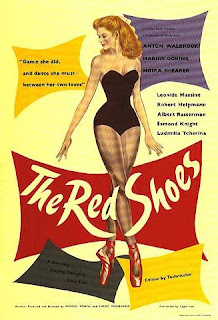
The Red Shoes (trailer) is a masterpiece in every conceivable way. It tells the story of Victoria Page (Moira Shearer), a beautiful, young ballerina who, as she herself says, lives to dance. She's taken on by Boris Lermontov (Anton Walbrook), the imperious head of an esteemed ballet company, who sees her potential to become one of the great dancers in the history of ballet, given the right training and motivation. But she soon meets Julian Craster (Marius Goring), the company's young and ambitious composer, and they fall in love; this enrages Lermontov, who fears that love will distract Page and hold her back creatively. Buffeted by ultimatums from Lermontov and Craster, Page finds herself in a love triangle, forced to choose between her life and her art.

First off, the film is breath-taking visually, Technicolor at its finest and most spectacular. The colors are luminous and crisp, and Shearer's bright red hair looks like it was made to be filmed with that particular process. The whole film is a visual wonder to behold, but this element becomes truly transcendent during the main ballet sequence, the performance of the ballet The Red Shoes, based on Hans Christian Andersen's fairy tale. Much like in Black Swan, the performance breaks the bonds of mere reality, as Page glides, leaps, and (literally) flies through a boundless environment of fantasy and pure emotion. Not to sound hyperbolic, but to me the ballet sequence is one of the greatest sequences committed to film, period.

Of course, the visuals aren't the only respect in which The Red Shoes is a triumph. The performances are uniformly excellent (assuming you don't have a problem with often melodramatic acting in a film about ballet), the drama is dynamic and stirring throughout, and its themes—above all the tragic strain of mutually exclusive but irresistable demands in one's life, in this case artistic creativity and romantic fulfilment—are profound and universal. I simply cannot recommend The Red Shoes enough. If you haven't seen it, see it immediately; if you have seen it, see it again.

Once I'd decompressed a bit from my viewing of The Red Shoes, I saw that the night was still young and thought I'd see what else Netflix Watch Instantly had to offer. I decided on Peeping Tom (trailer), having heard about it somewhere recently, but not realizing until it started that it's actually by the same director as The Red Shoes, Michael Powell. Turns out Powell and his frequent collaborator, Emeric Pressburger, were more or less the twin titans of 1940s British cinema, turning in The Life and Death of Colonel Blimp, A Canterbury Tale, A Matter of Life and Death, and Black Narcissus, in addition to The Red Shoes. However, Powell was working solo by the time he made Peeping Tom, a film starkly different from The Red Shoes in virtually every respect but their quality and their theme of irresistable, tragic compulsion.
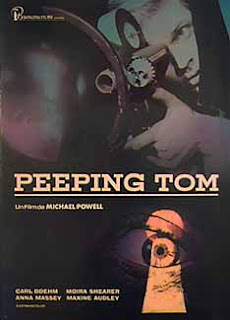
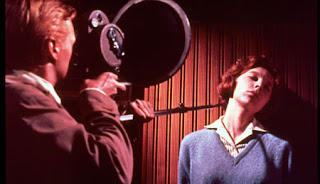
Mark (Carl Boehm) is a shy young film technician who always carries a hand-held camera and has an extensive filmmaking lab, screening apparatus, and collection of reels in his home. He's also a serial killer. His M.O. is murdering women with a blade attached to his camera's tripod leg, filming them while he does so and watching the films later. He becomes attached to Helen (Anna Massey), the young lady who lodges in Mark's house with her blind mother (Maxine Audley), but their budding relationship doesn't lessen his desperate need for voyeuristic violence, nor does the growing danger posed by the police investigation into his murders. (In fact, Mark displays the now-cliché behavior of the killer taking greater and greater risks out of apparent desire to be caught.)

While The Red Shoes revels in uplifting beauty and passion, Peeping Tom is sordid, unpleasant, and disturbing, especially for its time. (It apparently showed the first bare breast in mainstream British cinema.) Speaking of its time, it was released the same year, 1960, as another film by a British director about a psychologically disturbed but sympathetic serial killer of women, Psycho. While Psycho is more suspenseful and a greater overall filmmaking achievement than Peeping Tom is, the latter film is considerably more daring in how it depicts its killer. In Psycho, we think Norman is merely a dutiful son protecting his murderous mother until the climactic reveal, and the focus is usually on characters other than him (Marion, Sam, Lila, Arbogast). In Peeping Tom, however, we know from the beginning that Mark is the murderer, and he's in all but one or two scenes; the audience spends virtually the entire film following someone they know to be a serial killer.

Thematically, Peeping Tom obviously has a lot to say, beginning with Mark's symbolically loaded, if cumbersome, murder weapon. (No simple kitchen knife for Mark!) In addition to filming his victims, Mark mounts a mirror on his camera so that they see their own reflections as he kills them. So, in the darkened, quiet seclusion of his home theater (very much like a public theater), he watches these women watching themselves being murdered. And, of course, we both watch him watching them (adding another layer to the onion) and join him in watching them ourselves as though we're sitting there with him (making the audience an accomplice in his voyeurism, if not his violence directly). The role of Mark's camera is a pretty straightforward embodiment of the guilty thrill of witnessing violence (mediated and thereby dissociated from either danger to the viewer or real sympathy for the victim; "It's not real, it's just a movie"), but the role of the mirror is more complex and problematic. Mark explains that he's trying to capture the most perfect fear, the fear not of the violence itself but of their own fear, of the fear they see in their own reflections. Perhaps this is a comment on the filmmaker's manipulation of his audience in order to provoke emotional response and involvement, or on the audience's identification with what and who they see on film, or perhaps is a reiteration of the theme of the audience's reflexive involvement in, and thus partial responsibility for, what they see. (Probably all three, and even more that I didn't think of.) I think Scorsese was onto something when he said that the two essential films about filmmaking are 8 1/2 and Peeping Tom, Fellini exploring the exhuberant, life-affirming aspects of the art and Powell the sinister, transgressive, invasive aspects.
Another major element of Peeping Tom, and another it shares with Psycho, is male violence against women. Ever since these two "proto-slashers," women have been the primary victims of cinematic serial killers, and sex has been a major component. In Psycho, "Mrs. Bates" kills women to whom "Norman" is sexually attracted (attraction evidenced by his own "peeping tom" scene watching Marion throught a peep hole); in Peeping Tom, not only are all of Mark's victims women, but in the first scene he murders a prostitute, and in addition to his film-crew job he moonlights as a pornographic photographer. In one respect, this is just a reflection of the history, as old as humanity itself, of sexually motivated violence by men against women. Even relatively normal and sympathetic killers (in comparison to the more monstrous likes of Jason Voorhees, Michael Myers, and Leatherface) like Mark and Norman are depicted as socially isolated and emotionally stunted, with little romantic or sexual experience; desire becomes mingled with frustration and shame, and finds an outlet in violence against the objects of desire. Indeed, in Peeping Tom the themes of the dark sides of filmmaking and sexuality are both expressed in the word "object": Just as the camera creates a distance between filmer (and audience) and filmed, between subject and object, a distance and detachment necessary to kill a helpless, pleading victim, so too can sexual desire on the part of an emotionally immature (essentially adolescent) desirer result in seeing the desired simply as a thing to be selfishly enjoyed rather than as a fellow-person with her own life, wants, and fears. Both violence and pure sexual desire (that is, divorced from emotional involvement or empathy) involve a great deal of objectification, an effect essential to the mediating role of the camera.

Whew. I told you there was a lot going on in that film. I'll wrap this up by simply saying that I'd honestly never heard or been aware of Michael Powell prior to watching these two films, but that they were more than enough definitely to spur me to check out more of his and Pressburger's work in the future.

Friday, January 14, 2011

The Mustard-blood Must Flow


Having just watched it for the first time, I must say I've seen few films that combine the good, the bad, the derivative, and the head-scratchingly bizarre in such equal measures as Phantasm (trailer).

The low-budget 1979 "classic" horror film concerns restless small-town heartthrob Jody (Bill Thornbury) and his little sister Mike (A. Michael Baldwin), whom Jody's been raising since their parents' deaths. After the mysterious death-by-cemetery-sex of Jody's friend at the hands of a homely trollop (Kathy Lester), Mike grows suspicious of the town's eerie mortician (the awesomely named Angus Scrimm)—generally referred to as "the Tall Man," but to me he's Captain Underbite. Eventually Mike convinces Jody and their friend Reggie (Reggie Bannister), a creepy, guitar-playing, pony-tailed ice cream man, of the otherworldly danger posed by the funeral home and its mysterious owner.

First, the good. Phantasm is no mere slasher. The characters aren't just cannon fodder waiting to be murdered, but people whom the film takes the trouble to spend time with and explore outside of the context of the threat. You really buy the bond between Jody and Mike, Jody's longing to get away and start his life, and Mike's fear of losing the last remaining member of her family. Of course, Phantasm isn't really a family drama but a horror film, and the horror aspects are generally executed pretty well too. I can't help but think its $300,000 budget was a blessing in disguise, as it made sure that most of the tension and scares would come from what the audience can't see, creepy sounds and dark woods and hallways. I found that it was when I could actually see what was going on that the scares were less effective and often downright laughable, as with—Phantasm fans are going to hate me for this—the iconic flying chrome face-drilling, blood-spurting sphere-thing. (Here's a suggestion to writer and director Don Coscarelli: Just because something was scary in a dream you had doesn't necessarily mean it'll be scary on film.)

While some elements of the film, like the aforementioned sphere-thing and the labyrinthine halls of the funeral home, are quite unusual, a shockingly high number are very derivative, if not outright rip-offs. The biggest single victim of this is Dune (hence the post's title, along with the fact that all the creatures have thick, yellow, mustard-like slime for blood). Not only is the murder-sphere suspiciously similar (in function if not appearance) to a hunter-seeker, but while visiting a fortune teller Mike basically undergoes the "humanity test" administered to Paul, putting her hand in a box and undergoing extreme pain until she shows mental self-mastery. To top it all off, the fortune teller's granddaughter practically quotes the Litany against Fear when she tells Mike, "Fear is the killer." (The scene at the fortune teller's serves no narrative purpose but to convey Mike's anxiety about her brother's leaving and her need to conquer fear, both of which could've been conveyed without introducing extraneous characters and apparently genuine magic.)

The overall setting and tone seem like they could be straight out of any number of Stephen King novels: a small town, a contemporary setting (i.e., the '70s), a supernatural threat that's either unknown to or disbelieved by the general populace. (As I've said before, I've never actually read a King novel, but I've seen enough of the film adaptations to know to stay out of small-town Maine.) In addition, Phantasm features a homicidal, apparently driverless car (a hearse, naturally) à la Christine. Captain Underbite's horde of three-foot-tall zombies in hooded brown robes look just like Jawas. (Though Coscarelli gets points for making them more like the "genuine" zombies of Haitian voodoo, reanimated corpses obeying another's will, than the all-too-prevalent Romero-style zombies.) And the theme song is strongly reminiscent of those of The Exorcist, Suspiria, and Halloween, though, to be fair, that probably has more to do with '70s horror's affinity for repetitive piano-plinking than with Phantasm ripping anyone off.

As the previous paragraphs no doubt indicate, Phantasm is a pretty weird film, and its weirdness reaches a dizzying crescendo as the end draws near . . .

— SPOILERS AHEAD, BOY! —

So Jody and Mike (independently) infiltrate Captain Underbite's funeral home, where they run into Reggie, previously thought dead, who's already released some of Captain Underbite's still-living prisoners, who then ran off "like scared rabbits." The three proceed into the Hall of Purple Plastic Drums—it's a white room lined with stacks of . . . purple plastic drums (containers, I mean, not instruments)—where Mike is sucked into some kind of portal and sees a long line of Jawa-zombies doing something amidst a red-skied, wind-swept landscape. Jody and Reggie manage to pull her back, and Mike then explains that Captain Underbite is reanimating corpses to use them as slave labor on another planet, and that they're so short on account of the planet's greater gravity and heat. (How she learnt all this, I have not a clue.) The lights in the Hall of Purple Plastic Drums then go out, and Mike is attacked by Jawas. The next we see of them, Reggie is alone in the Hall of Purple Plastic Drums, while Jody and Mike are now inexplicably outside the funeral home, separated. There they are stalked by the knife-wielding homely trollop, who's actually Captain Underbite in another form. (In which case, the fact that she (he?) murdered Jody's friend at the beginning was an act of kindness of sorts; I can't imagine he'd want to go on after finding out he'd just banged Angus Scrimm in a cemetery.) Just then, though, Reggie (who, as a musician, knows all about tuning forks) touches two tuning-fork-like bars in the Hall of Purple Plastic Drums, causing them to stop vibrating (or at least humming). This harms or weakens the homely trollop in some way. While Jody and Mike are still wandering around outside looking for each other, Reggie escapes from the Hall of Purple Plastic Drums, runs out of the funeral home, and sees the homely trollop lying on the ground; he goes over to help, and she promptly stabs him to death and transforms back into Captain Underbite. Jody finds Mike, tells her that Reggie's dead (which he can apparently diagnose from some distance away, at night), and they escape back to their house, where they promptly split up (brilliant!). Captain Underbite shows up and chases after Mike, but she manages to conquer her fear and follow her brother's overly complex plan of luring Captain Underbite out into the woods, tricking him into falling down a thousand-foot abandoned mine shaft, and rolling a boulder onto it to block it up. Safe at last . . .

Except that it was all a dream! Mike wakes up to a fate worse than death where Jody was killed in a car accident and she's being raised by Reggie, the—just to reiterate—creepy, guitar-playing, pony-tailed ice cream man. (You better get Child Protective Services on speed-dial, kid.) After a little cuddle by the fire with Reggie, Mike goes to her room . . . only to find Captain Underbite there, who pulls her into a mirror! Roll credits.

Phantasm was clearly a labor of love for Coscarelli and the rest of those involved. It was produced on a shoe-string (it's really remarkable how polished and professional it looks, considering), was filmed on week-ends over the course of about a year, and once completed was threatened with an X rating before the M.P.A.A. relented. (Hey, Phantasm and Blue Valentine have something in common!) As with a lot of low-budget independent films, the passion and personal vision are almost tangible. Though to a great extent I'm impressed with its uniqueness—and especially the crew's ability to bring that uniqueness to life as well as they did for what's chump change in the film industry—I also think its greatest weakness is that uniqueness, that personal vision. To anyone accustomed to how stories have been told for the past few tens of thousands of years, the plot of Phantasm makes no sense. A murderous, shape-shifting, superhumanly strong mortician/alien/demon/monster/whatever? Three-foot-tall hooded zombies as interplanetary slaves? A chrome sphere that flies around a funeral home killing people? A severed finger that bleeds mustard and turns into a giant flying beetle? A magical fortune teller for no apparent reason? An heroic ice cream man? It was all a dream? Coscarelli clearly had a lot of story to tell (the original version would've run three hours) and a lot of ideas for both the drama and the horror, many of which sound interesting individually, but which don't really cohere in any rational way. Phantasm is probably among those instances **cough** Star Wars prequels **cough** Southland Tales **cough** where a well-meaning filmmaker exerting total creative control over a film wasn't ideal for the final product. Nevertheless, I can't help but recommend it for anyone interested in genuine scares, suspense, and a crazy, one-of-a-kind cinematic trip.

Tuesday, November 10, 2009

Best Date Movie Ever


It's been about two weeks since I saw Lars von Trier's latest, most controversial film (trailer and clip), and I have to admit I haven't made a lot of headway in wrapping my head around it or parsing its many elements. (Not to point any fingers *ahem* but it hasn't helped that I haven't had anyone else to discuss it with.) So don't expect too much in the way of full-fledged analysis or brilliant insights here; I'll be the first to admit that with this film, I'm pretty far in over my head. I may not have really understood Antichrist, but I was awestruck nevertheless.

The film begins—its "prologue" is so similar stylistically to the opening sequence of The Fall, with its breathtakingly beautiful black-and-white photography of initially seemingly disparate images, shot in glacial slow-motion and silent except for its classical score (in Antichrist's case, Handel's Lascia ch'io pianga), that von Trier might need to worry about a call from Tarsem's lawyers—with a couple (Willem Dafoe and Charlotte Gainsbourg) passionately making love, while their toddler son escapes from his crib, climbs out an open window, and falls to his death. Months later, he seems to have come to terms with it, while she's still tormented by guilt and grief. A therapist, he's distrustful of her doctors and the medications they prescribe her and takes her emotional recovery upon himself; meanwhile, their marriage becomes increasingly strained, with their child's death bringing latent dissatisfactions and resentments to the surface. Insisting that she face her fears head-on in order to overcome them, he takes her to the place she says she fears the most: Eden, their isolated, rustic cabin in the woods. Once there, he has her undergo several tests and exercises in hopes of getting to the bottom of her feelings of guilt toward their son, her increasingly unstable (almost bipolar) feelings toward him, and her powerful, seemingly irrational fear of nature. (As she tells him at one point, chillingly dispassionately, almost as a non-sequitur, "Nature is Satan's church.")

Watching Antichrist, I was alternatingly entranced and repulsed. The cinematography is stunningly beautiful, especially of the woods surrounding Eden. Dafoe and Gainsbourg both deliver fantastic performances, particularly Gainsbourg (winner of the best-actress award at Cannes this year), who's at times coldly calm or indifferent, as if in shock, and at others bestially, ferociously passionate, with emotion pouring out from the depths of her soul. Thematically there's so much going on that I don't really know where to begin: gender, power, sexuality, guilt, fear, loss, revenge, violence, life and death, rationality, history, man in nature, man against nature, nature against man, fantasy and reality, archetypes, modernity, health, psychology, just for starters off the top of my head. A library's worth could be written about this film. It also doesn't flinch from depicting graphic violence and sex—in some cases at the same time. At times it was terrifying, gruesome, and pretty difficult to watch; that isn't a criticism, but puts in alongside other great, very unpleasant films like Requiem for a Dream, United 93Funny Games, and Come and See.

A lot of the controversy surrounding Antichrist comes from its perceived misogyny, but that seems to be a somewhat simplistic take. It's true that the film's concerned with the differences, real or perceived, between men and women, and that in many ways the husband acts in a traditionally masculine fashion—rational, in control, methodological—while the wife acts in a traditionally feminine fashion—hyper-emotional, even hysterical at times, without the ability (or perhaps desire) to cordon off and set aside her feelings. But it would be a mistake simply to read the film as saying, "When men grieve for a dead child they're all like this, but when women grieve for a dead child they're all like this" (said like a bad stand-up comic). The wife ends up doing some pretty atrocious things to her husband and herself by the end of the film, but I can't really say yet that von Trier intended those things to be a condemnation of her or of women in general. (That's what keeps it from being an art-house torture-porn version of The Room; both von Trier and Wiseau made their films from an intensely personal, emotional place, but somehow I don't think von Trier made Antichrist to get back at a girl who'd dumped him.) I can't say I have a definite, or even vague, answer at this point, but there's just too much going on simply to write it all off as a woman-hating screed.

Though I may never muster the courage to watch it again, knowing now what I'd be getting myself into, Antichrist is certainly one of the best films of the year, and among the most beautiful, most challenging, and most frustrating I think I've ever seen. I've heard it described as von Trier's take on the horror genre; toward that end, he was able to imbue it with an unspoken sense of threat and foreboding long before the fantastical, bizarre, and gruesome events toward the end. (For instance, there's a very Lynchian shot, at the end of the scene early on of the husband visiting his wife at the hospital, that centers on the seemingly empty space between them and very slowly zooms in on the vase of flowers on the table beside her bed until the screen is filled with the green, murky water in the vase, as the monotonic score hums boomingly; very, inexplicably unsettling. Lynch is a master of making the mundane creepy; if you're going to borrow, borrow from the best.) I haven't seen much of von Trier's filmography, just Dancer in the Dark (trailer), another unpleasant film about which I found things both to like and dislike. Having seen Antichrist, I may have to man up and see some of his other films (about which I've heard good things, but which are supposed to be similarly hard on the audience); whatever the have in store for me, at this point I can't say I wasn't warned.

Sunday, October 11, 2009

Die Yuppie Scum!


I'd like to begin by offering a hearty "hear hear!" to Mr. Sendak.

Moving on, as I've said before, I'm by no means a horror aficionado. However I like to think that doesn't prevent me from being able to distinguish the good examples from the bad. I agree that, despite its weaknesses, Paranormal Activity is one of the good examples. For me, really the sole interest run-of-the-mill horror films have for me is the gruesome deaths, which are rarely, if ever, genuinely scary; they're so formulaic that you can almost always see them coming a mile away, so it's really about the sadistically gleeful anticipation of some hapless red shirt's demise. On the other hand, we have films like The Shining, The Blair Witch Project, PsychoAlienCarrie, Rosemary's BabyThe Orphanage, The Ring (I mean the Japanese original; I haven't seen the American remake), The Others, and del Toro's films, which earn their scares by slowly, carefully building suspense instead of just hacking apart a bunch of people the audience doesn't care about. As you note, however, films like these are much more the exceptions than the rule, with audiences—if the vocally unsatisfied theatergoers leaving Paranormal Activity as we waited for our screening were any indication—evidently prefering a rapid series of graphic kills to slow-burning tension that actually gets under your skin.

(As a side note, I don't see how you can claim that "horror" has become too denigrated to use as the name of this genre, especially when the name you suggest in its place is "scary movie." Now that's denigration.)

On the plus side, Paranormal Activity eschews a series of graphic kills and jack-in-the-box scares in favor of establishing characters in whom the audience can invest, setting it in realistic surroundings, preying on real-life anxieties (I think people are more freaked out by weird sounds in the night than by hockey-mask-wearing mutes out in the woods), and giving the film time to build genuine suspense. On the minus side, however, the scares are almost always even easier to see coming than in your standard slasher movies. I knew that something was coming each and every time we saw the late-night footage of their bedroom, and knew exactly when it was coming when the footage stopped fast-forwarding; I mean, after the second or third time I literally just watched the clock in the lower-right corner and waited for it to stop fast-forwarding. The only uncertainty at that point was what was going to happen each time, which the film generally did a good job with; I was genuinely surprised when Katie stood beside the bed for hours, and when she was dragged out of bed and down the hall.

Another problem with the film was the characters, Micah—your name's pronounced "My-cah," dummy, not "Mee-cah"—and Katie. They reminded me of the characters in Cloverfield, lazy, privileged, self-absorbed yuppies I couldn't care less about and in fact was actively rooting against. (My thanks to Patrick Bateman for this post's title.) This was only magnified by what an absolute tool Micah is in almost every scene of the film, going from poo-pooing Katie's fears and the psychic's warnings about antagonizing the spirit, to taking it so seriously that he seems to want to take it on single-handedly out of unthinking macho bravado. (I wouldn't have been surprised if he'd challenged the spirit to "throw down, chief!") Speaking of the psychic, I kinda couldn't blame Micah for not taking him seriously, with his talking about these phenomena with practically scientific exactitude ("It's a demon, not a ghost." "In such situations, what typically happens is..."); maybe there's a peer-reviewed journal he could refer them to (other than the picture book Micah was reading and treating like a scientific textbook). Katie was the best character in that I didn't actively dispise her, though I couldn't help but keep thinking of her as Pam Beesley with bigger breasts and no job. (Actually, it would've been great if we'd had Jim and Pam instead of Micah and Katie; a lot more wisecracking and mugging for the camera.) That's another thing, how contrived was it to have Micah be a day trader (remember those?) and Katie a grad student, just to give them an excuse to stay at home all day, every day talking to the camera? Are we seriously supposed to believe that an unmarried twenty-something couple can afford a beautifully furnished three-bedroom house in San Diego, a convertible, and a graduate-level education simply by trading stocks online (when he isn't following Katie around with the camera)?

These problems with the characters weren't helped by the actors' performances, which were basically community-theater level. I realize they aren't supposed to seem like "actors," but when almost the whole film is spent with the camera in their faces, I can tell the difference between "real people" and "bad actors." (There are plenty of examples of great performances by nonprofessional actors, such as the Italian neorealists (de Sica's Bicycle Thieves and Umberto D., Pasolini's The Gospel According to Saint Matthew), Black Orpheus, Van Sant's Elephant and Paranoid Park, Bruno S. in Herzog's The Enigma of Kaspar Hauser and Stroszek, R. Lee Ermey in Full Metal Jacket, and Oscar-winner Dr. Haing Ngor in The Killing Fields.)

So I think that Paranormal Activity has a lot going for it, and I would recommend it to those tired of slasher flicks and torture porn and looking for a breath of fresh air in the horror genre. I wouldn't recommend it to those looking for good acting, enjoyable characters, or scary scenes in which you can't predict with pin-point accuracy when the scare is going to come.

P.S. — By "the classic that was filmed in our area," I assume you're referring to Body of Evidence (trailer), filmed in Portland and starring the acclaimed thespian Madonna.

Saturday, October 10, 2009

Do you like scary movies?

Seeing as how it is now October, it seems about time to bring up the topic of Halloween movies, and I do not mean necessarily Michael Myers. Well that and we saw Paranormal Activity (trailer) and it got me thinking of how movies tackle the idea of terror in movies. I personally have a love-hate relationship with "horror" movies. The love part is that I leave being scared and the hate part comes because most of them are, well, bad is probably a nice way to put it. My dislike of the concept of genre rears its head again as a number of awful movies are made with no effort at quality because they are unabashedly genre movies and supposedly are not expected to do anything more than just cause teenagers with too much time on their hands to jump out of their chairs a few times and maybe shout at the screen. When a slasher movie gets its frights out of exposing the audience to gruesome visuals or delivers jack-in-the-box-like effects toward the screen, I just yawn. Sure those moments when something pops in front of the screen might make me jump as much as the next guy, but in between those scenes I could care less. Gore for the sake of gore also does nothing for me and consequently the emergence of torture porn to supplant the scream queens had not improved the situation.

So that being said, film is a great medium for scaring people and it disappoints me that so few movies take advantage of the opportunity. The big screen and dark auditorium -- at least for those who see it at a theater -- are probably the best environment to escape reality and the tools a filmmaker has in controlling the visuals and audio allow manipulation of mood and tone that are much less effective in realms such as theater and books. Consequently there are a number of scary movies (a term I prefer to horror because of the way that word has been denigrated in the realm of film) that I enjoy quite a bit and those experiences where I am on the edge of my seat in suspense make up some of my favorite film watching. I think I have mentioned to you that when I lived in Alabama I would try to rent movies that would legitimately scare me as a way to make my life more interesting. So I've seen The Omen and Cujo and What Lies Beneath (the last one being one of the scarier of the startling movies) among others, but would not say I am an expert. So the point of this post is just to toss out some titles I think are worth watching in the month of October and perhaps start a discussion with you and maybe even our readers on what could be added to the list.

I should start the list by discussing the movie we just watched -- Paranormal Activity. The best part of watching this movie was that I knew nothing about it going in aside from the fact that it was made for like $10,000 (which I now discover is $15,000), which is truly the best way to go into it. Although I'm fairly certain that pretty much the extent of our readership was at the movie with us, I will shy away from saying too much about the plot so as not to give any spoilers and allow others to have the same experience as me. But the basic idea is a mocumentary of a young couple trying to catch on film evidence of a paranormal entity in their home. The entire movie takes place at the house and uses the unknown to create the tension in the movie. It slowly builds to the point where every time it would show the couple lying in bed, the audience would either gasp our shout at the screen in anticipation of what slight addition to the story would develop (side note there: this is not a movie for the standard horror crowd and is much slower and character-centric, leading to a lot of screaming when it was not that kind of a scare and complaining by the mostly teenage crowd in the theater with us that the movie was lame). What I liked about the movie is that it felt believable even though I do not believe in the paranormal, ghosts, demons, etc. and I did find my heart beating faster as it built toward the climax. It did seem to start out awfully slow, but on the whole the ability of the movie to slowly ratchet up the tension was rather masterful. You have mentioned you are considering writing about this film so although there is a lot more I find fascinating about this movie, I think I will leave that either to yours or a possibly response to your post. I already saw as I was writing this post that a commentator brought up particularly noteworthy element, which is that there was a Hollywood remake planned but scrapped when they decided to just release what they had already in the can (original version FTW!).

So on to the topic of other scary movies. The obvious relative to this is The Blair Witch Project -- another low-budget mocumentary made with no script and for next to nothing. That film, about people terrified in the woods, scared a lot of people and left many others not knowing what to think. A number of people told me they didn't find it scary at all and in conversing I came to realize they were not scared because there weren't a lot of those startling moments as found in many horror movies. In other words, the dumbing-down of the movie of film horror has meant that we expect immediate gratification of being frightened instead of having a movie slowly get under our skin. I would say that this movie is one I wouldn't mind watching again as I can honestly say I hardly remember it. What I do recall, however, is feeling like I was genuinely sharing in the terror that the characters were experiencing, and in that Paranormal Activity lived up to its predecessor.

So what other movies can I think of that I enjoyed? I don't want to exhaust the list so I will just list a few good examples of scary movies. The gold standard in my book (as mentioned before) is The Shining -- a Stanley Kubrick interpretation of Stephen King's novel starring Jack Nicholson. There are several reasons this movie is so scary and I would summon it up to three main reasons: (1) Kubrick is a master of using the visuals to throw the audience off guard, (2) the terror in the movie is very down-to-earth and realistic, and (3) Nicholson's creepy performance -- one of the best of his career.

Foreign horror movies are not generally an area in which I am an expert (I leave that more to you), but the political and familial aspects of The Host made it a great modern monster/scary movie and I like the way that Guillermo del Toro uses a sense of history in The Devil's Backbone to tell a story that is both more fantastic yet realistic as it draws a connection between the horror of war and that of the undead. He uses a similar approach in the more acclaimed Pan's Labyrinth, but I found the earlier movie to be more in line with a scary movie.

With that I have thrown some titles out there, but I have certainly not exhausted the list (in fact, I have left out a classic that was filmed in our area) and look forward to seeing if you or any others have more to add to the list.

Wednesday, October 7, 2009

Ø Brothers, Where Art Americanized Remakes?


On second thought and sober reflection, that's a really dumb post title. Oh well, it stays.

Though I haven't seen the original Danish version of Brothers (and my time machine's in the shop, so I haven't seen the American remake either), you raised some interesting points in your last post that I'd like to address.

To remake or not to remake. Whether 'tis nobler to introduce great stories from foreign films to wider American audiences, or just to say "No, sorry, sometimes watching a great work of cinema means having to read a little." It's kinda a tough call. My first instinct is to condemn remakes, updates, reboots, etc. and to encourage people to embrace the original instead, even if it's in another language, in black and white, or doesn't have any actors you recognize from the covers of People, Us Weekly, or Tiger Beat. But that would make me a hypocrite, wouldn't it, since only a couple posts ago I was gushing over a trio of great remakes. There have been plenty of good, even great, remakes of older foreign films, from The Departed, which you mentioned, to The Good Thief (based on Melville's Bob le Flambleur), Twelve Monkeys (based on La Jetée), A Fistful of Dollars (based on Kurosawa's Yojimbo), and, of course, Star Wars (based on The Hidden Fortress, also by Kurosawa). (Here is a handy list of English-language remakes of foreign films. Of course, this kind of influence is a two-way street; for example, two of Kurosawa's films, Throne of Blood and Ran, are based on Shakespeare, Macbeth and King Lear respectively.)

One particularly interesting example, discussed previously, is Funny Games, originally made in 1997 in German, remade in 2008 in English. Both were directed by Michael Haneke (who won the Palme d'Or at Cannes last spring for his most recent film, The White Ribbon), using the same script and all the same shots; the only differences were the actors and the language. I suppose Haneke did this to expose a wider audience to the ideas in the original; I doubt he was just trying to cash in on the American market, since there are a lot more audience-friendly stories out there if you're just trying to make a buck. Regardless of his motivation, it almost can't be considered a remake, since there's virtually no creative difference between it and the original; except for the actors' performances, you might as well be watching a dubbed version of the original.

The main reason why this issue is of interest to me is the forthcoming American remake of the 2008 Swedish film Let the Right One In (trailer), my number 2 film of that year. It has fantastic, understated performances, particularly on the parts of its child-leads, Kåre Hedebrant and Lina Leandersson; its cinematography and music create a beautiful, almost dreamlike atmosphere; and the story has a mixture of innocence, uncertainty, and fear that's particularly appropriate for a film about adolescence. Oh yeah, and it has a deathless minion of Hell damned to feed on the living for all eternity, so basically it's the total package. It's been out on DVD for a while now, and I would've bought it in a heart beat, but the English subtitles in the DVD version are significantly different, and vastly inferior, to those in the theatrical version. Why they would do that I have no idea, but it breaks my heart; I'm almost tempted just to learn enough Swedish to avoid the subtitles altogether. The North American distributer, Magnolia Films, has said it would release a version with the theatrical subtitles, but I haven't seen it yet. This isn't the first time I've been burnt by shoddy subtitles to the foreign films I love; I saw Park Chan-wook's Oldboy twice in theaters, and I'm positive the subtitles in my DVD are different. Seriously, this crap make me pull my hair out.

To get back on topic, the American remake is scheduled for release next year, with Matt Reeves (The Pallbearer (a David Schwimmer vehicle—I didn't even know there was such a thing), Felicity, Cloverfield . . . ugh) directing. Some casting news came out recently, with Kodi Smit-McPhee (soon to appear in the adaptation of The Road) and Chloë Moretz (recently in (500) Days of Summer, also in the upcoming adaptation of the comic book Kick-Ass) as the two kids and Richard Jenkins as the girl's "guardian." It's good to see they're keeping the kid characters young (Smit-McPhee is 13, Moretz 12) instead of going the more bankable, less squicky route of teen actors, as is Oscar-nominee Jenkins's involvement. There had previously been noises that Philip Seymour Hoffman would get that role, but I won't lose any sleep over Jenkins getting it instead. Hoffman would've captured the sad-sack-schlub aspect of the original's character (I'm imagining his roles in Happiness and Synecdoche, New York), but Jenkins can evoke a tired, forlorn quality (seen to such great effect last year in The Visitor) that I think would work great as well.

Though the casting seems promising, other elements—in addition to Reeves's filmography—are less so. First off, it may get a different title, "Let Me In" or "Fish Head." The former refers to a particular scene in the film, but in a slightly more obvious way than "Let the Right One In" does; as for "Fish Head," I haven't the slightest clue. Also, the original's director, Tomas Alfredson, made the good point that it doesn't make a lot to sense to remake what is already a fantastic film, especially so recently afterward. It threatens to distract from the original people who might otherwise see it, offering in its place a work that, even if as good as the original, is merely piggy-backing on its ideas.

In a move that may work for or against his film, Reeves apparently wants to hew more closely to John Lindqvist's novel. (Of course, he's already failing to do that by changing the setting from Sweden to the United States, isn't he?) I mention this because it's good to keep in mind when discussing remakes that the original film isn't always a canon from which any deviation is necessarily wrong; originals are themselves often based on their own source material, deviation from which may help or hurt them. So we'll have to see what impact that has.

Another reason the remake leaves a bad taste in my mouth is that it seems a bit like a cashing-in on the explosion of all things vampiric in popular culture right now. (A few years ago it was zombies, starting with Danny Boyle's 28 Days Later in 2002; the zombie renaissance seems to have mostly burnt itself out by this point, except for the occasional film like Zombieland that takes a slightly different approach from the well-worn "motley crew of survivors spend the running time killing the undead in gruesomely creative ways, most of them dying themselves along the way" template.) Since Stephanie Meyer's Twilight novels started making big bucks, it seems like you can't walk ten feet without seeing a new vampire-themed film or TV series, be it the films Twilight and New Moon, True Blood, Cirque du Freak: The Vampire's Assistant, Daybreakers, the inexplicable continuance of the Underworld franchise, etc., etc., etc. On the one hand, Reeves has some of the best source material—cinematic and (presumably) literary—that one could hope for; on the other, he is apparently going in a more "accessible" direction. As long as he doesn't have his young vampiress sparkling or playing baseball, I guess that'll be some kind of victory, at least.

Anyway, that's what I have to say about American remakes of foreign films (at least until I see either version of Brothers and can comment directly). I also agree that there doesn't seem to have been any high-quality films about the Afghan or Iraqi wars other than Kathryn Bigelow's outstanding The Hurt Locker this summer. I don't have a whole lot to say on this point; honestly, I think The Hurt Locker is the first I've seen because, well, the others weren't supposed to be that great. Maybe it's a matter of needing a little more distance from the subject matter, maybe it's just the fact that, regardless of subject matter, a lot more crappy movies are made than good ones. Keep in mind that it took a while for films like The Deer Hunter (1978), Coming Home (1978), Apocalypse Now (1979), Platoon (1986), and Full Metal Jacket (1987) to come out; prior to that, it had mostly been the Duke kicking VC ass in The Green Berets.

— — —

On an unrelated note, here are some great, insightful interviews with Stanley Kubrick, the tenth anniversary of whose death was last March. There's one each on A Clockwork Orange, Barry Lyndon, and The Shining. Enjoy!

Friday, September 18, 2009

Fifties, meet the Eighties. Eighties, Fifties.


And you thought film studios were remake-happy nowadays. For one reason or another, the 1980s saw a series of remakes of classic sci-fi/horror movies from the 1950s. These weren't just any remakes, however, but works of cinema that not only stand on their own two feet but in many respects outdo the originals. Sometimes they follow the original pretty closely (The Blob), sometimes they use the original as little more than a jumping-off point (The Thing, The Fly), but in all three cases we're treated to entertaining, shocking, expertly crafted science-fiction filmmaking of the highest level.

(OK, caveat time. I write this post with a bit of trepidation, since the only one of the '50s originals I've actually seen is The Fly, and that was only once many, many years ago. That said, I don't intend to talk that much about the originals anyway, since the post's ostensible '80s-remake-of-'50s-scifi-classic theme is actually little more than an excuse to talk about three awesome '80s sci-fi/horror movies. The fact that they're all based on '50s originals doesn't really affect what I think of them, it just helps me to lump them together. Whew, I'm glad I got that confession off my chest.)

— SPOILERS . . . FROM ANOTHER WORLD! —

The Thing (trailer), directed by the great John Carpenter and released on June 25, 1982—the very same day as another high-water mark in cinematic science fiction, Ridley Scott's Blade Runner—is loosely based on 1951's The Thing from Another World (trailer), directed by Howard Hawks (but credited to Charles Nyby), itself based on the 1938 novella Who Goes There? by John Campbell. (In a counter-example to the general trend of adaptation decay, Carpenter's film is more faithful to the novella than Hawks's.) In Carpenter's film, a sleepy American outpost in Antarctica becomes the scene of a strange attempt by Norwegians from a neighboring outpost to kill a sled dog. The Norwegians are killed and the dog taken in by the Americans, but they soon learn that the dog is actually an alien, discovered in the ice by the unfortunate Norwegians, that can copy and assimilate other organisms, including humans. Isolated and afraid, they try to figure out who on their small crew is still human and who is already a "thing" bent on assimilating the rest.

Simply put, this is one of my favorite movies ever. First off, it's got a ridiculous cast, with Kurt Russell (fresh from working with Carpenter on Escape from New York), Keith David (who would go on to work with Carpenter on They Live and narrate those Navy recruitment ads—"Accelerate your life!"), Wilford Brimley (yes, that Wilford Brimley!), and Thomas Waites (who got run over by a subway train in The Warriors), among others. Carpenter makes this sausage-fest interesting by imbuing it with so much suspense and claustrophobic dread that you're almost afraid to move; he's greatly assisted in this by a simple, ominous score by the master himself, Ennio Morricone.

As great as so many elements in this film are, the real star of The Thing is the special effects. The 1980s were a golden age of practical effects, when the technology and skills were at their most advanced but before computer-generated effects started taking over in the 1990s. (Digression/rant: The problem with CG effects, even when done impeccably well, is that they take the wonder out of special effects. With a few taps on a keyboard you can make literally anything imaginable. Practical effects, which actually have to exist in three-dimensional space and obey the laws of physics, require a staggering—indeed, inspiring—amount of skill, ingenuity, and dumb luck to pull off. If done well, the payoff is special effects that not only look far more real than any CG effect—because they are real—but make the audience's jaws drop as they wonder, "How'd they manage to do that?" Though we've seen some filmmakers reject the Lucasian excesses of CG effects and embrace practical effects—notably del Toro in HellboyPan's Labyrinth, and Hellboy 2—we still have a long way to go before we'll see practical effects return to their '80s glory. Now back to our regularly scheduled programming.) Though all three of these films—and many others from the era; An American Werewolf in London (example) and Videodrome (example) come to mind—have some fantastic practical effects, The Thing is simply head and shoulders above the rest. From the dog-thing's transformation in the kennel to the defibrillator scene (doesn't Palmer (David Clennon) just sum up the situation perfectly?) to Blair-thing's stretching apart Garry's face at the end, The Thing just goes from triumph to triumph effects-wise. This is real "movie magic" (even if it feels less "magical" than "stomach-turning"). The combination of astonishing special effects, a great cast, an intriguing story, palpable atmosphere, and brilliant execution on Carpenter's part makes The Thing an unforgettable film.

The 1986 remake of The Fly (trailer) has the same basic premise as the 1958 original (trailer)—a scientist invents a teleportation machine but teleports himself with a fly in the machine with him, causing him to turn into a half-man, half-fly mutant—but David Cronenberg departed from the original significantly, in both story and tone. The original is told in flashbacks, as a police inspector tries to get to the bottom of why the scientist's wife killed him. In the end, we find out that the scientist's head and arm turned into those of the fly, and the fly's turned into those of the scientist—leading to this particularly disturbing classic climactic scene. Cronenberg's film, on the other hand, is structurally more straightforward, simply telling the story of Seth Brundle's last weeks chronologically. Wasting no time, the film begins when Seth (Jeff Goldblum) invites journalist Ronnie (Geena Davis) back to his home/lab to show her his teleportation pods (no, that's not just his pickup line); they become lovers while he continues to work the kinks out of his invention, but soon he follows in his 1958 predecessor's footsteps and tests it on himself without checking for insect interlopers first. Unlike the switcheroo scenario in the original, Seth and the fly have their genetic material fused into one being, initially simply Seth with greater strength and reflexes but eventually mutating into an increasingly fly-like state, becoming "Brundlefly."

Structurally the film is very simple: three characters (Seth, Ronnie, and Ronnie's scuzzy editor Stathis (John Getz)), begins with Seth and Ronnie's first meeting, ends with his death. Unlike the original, there's no mystery; we see everything that happens to Brundle over the course of his mutation (often in gruesome detail). The story doesn't derive its power from some classic sci-fi "big reveal" but from witnessing what happens to Seth as he physically, and eventually psychologically, loses his humanity. The film is a tragedy of the Classical sort, in which the protagonist is brought to ruin by his own faults and excesses, in Seth's case a pride and ambition on display from the very first scene. What's so heartbreaking is that he never fully loses his humanity; even at the very end we can still see a man in there, a twisted remnant of the brilliant, handsome, charming man we saw at the beginning. The intimacy of the story, Cronenberg's expert blending of the dramatic and sci-fi/horror elements, Howard Shore's terrific score, and the realistic immediacy with which the tragic consequences of Seth's hubris are depicted (i.e., the graphic body horror) make The Fly a powerful experience, both visually and emotionally.

The Fly is another '80s high-water mark in practical effects, in this case primarily the makeup and costume work for Seth Brundle. David Cronenberg is the King of Body Horror; this is displayed not only in his earlier films like The Fly, Videodrome, Scanners, Naked Lunch, and eXistenZ, with their blurring of the line between machine and body (bodies used as machines, machines united with bodies, one transforming into the other, the machine-like manipulation of bodies, etc.), but also in his more recent, somewhat more mainstream films like A History of Violence and Eastern Promises, with their often unflinchingly graphic depictions of violence. The Fly is the cornerstone of Cronenberg's filmography in this regard, with the entire film centering on the grotesque transformations the protagonist undergoes: the inside-out baboon, the arm-wrestling match in the bar, the deterioration of Seth's body, his climactic final transformation into Brundlefly. Considering the mutation's centrality to the story, the film simply wouldn't work if the effects weren't convincing; the emotional power that The Fly conveys is therefore a real testament to the special-effects craftsmanship on display.

One final note on The Fly: Cronenberg and Oscar-winning effects artist Chris Walas should've at least gotten a "special thanks" credit in District 9, considering how indebted that film was to The Fly, from the progressive mutation to finger nails peeling off to the sympathetic protagonist's bewildered, terrified reaction to what's happening to him. District 9 was great, but in a lot of respects it was standing on the shoulders of giants.

Finally, The Blob (trailer). Honestly, this 1988 remake of the 1958 original (trailer) starring Steve McQueen isn't as good as the other films discussed in this post, and I haven't seen it in several years. It may not have the suspense of The Thing or the pathos of The Fly, but it's still a solid movie with generally decent special effects—especially when the Blob is dissolving some hapless earthling. It's also got a secret weapon: Kevin Dillon. That's right, Johnny Drama himself has a starring role in this flick! If that's not enough to convince you you're in the presence of quality cinema, it's got some great, gruesome kills—the guy trying to cop a feel on his date (here, starting at about 1:20) is one for the history books—including a bona-fide kid kill (sorry, I'm not linking to that, you'll just have to watch the movie). This is a movie that doesn't make you think or feel too much; it just offers up an hour and a half of slimy, gelatinous entertainment full of unsuspecting townsfolk and their awesomely disgusting demises. What more could you ask for from a movie about a giant, man-eating wad of mucus? (The answer is "not that much," considering it's not exactly a very compelling antagonist.)
— — —
Though technically a couple years too early, the 1978 Invasion of the Body Snatchers (trailer) would be interesting to compare to the 1956 original (trailer), with their different takes on a common theme of paranoia and social/political anxiety—especially since I've actually seen the original. But that'll have to wait for another post.